Look Up by Ringo Starr: Album Review

Reviewed by Jordan Frazer

If you look at Ringo Starr’s vocal contributions to The Beatles’ albums, it’s no wonder that he cited country music as his favourite genre in his recent interview on Jimmy Kimmel Live: ‘…we got a three month job and we all changed our names. I thought…Ringo – cowboy’.

Ringo’s always just wanted to be a cowboy. And Nashville loves him like a son. He was on the show to promote Look Up – his first full LP since 2019. Recorded mostly in Nashville, Tennessee and released (in hard copy and digitally) on 10th January 2025, Look Up contains 11 new original songs, is produced by country powerhouse T Bone Burnett and features musical collaborators Molly Tuttle, Billy Strings, Lucius, Larkin Poe and Alison Krauss. Oh, and it’s also Ringo’s first ever No.1 album.

Track by track
‘I’m on the train to Liverpool…I have Ringo Starr’s new record as my companion…As each track concluded, I found myself sending a short message to my brother T Bone Burnett…’ Adopted-Scouser, Elvis Costello’s liner notes to Look Up provide a real-time, track-by-track reaction to the 11 songs. It’s a style of review that matches the immediacy of the record. A record from everyone’s favourite adopted-cowboy. And so, when tasked with reviewing it myself, that’s what I did

1. Breathless
The boy from the Dingle’s drums lead you straight in, and there’s no doubt you’re in Nashville. Stylistically, it leans a little too-heavy into the blues and so is not the strongest opener, but the ambience it creates forgives those compositional shortcomings: it’s like you’ve been dragged off the street into an eternal barn dance, Ringo on the stage, backed by his band of virtuoso outlaws. ‘Breathless’ establishes
the performance themes of the album: attractive arrangements, played with feeling, never over produced, a live sound: quintessentially Country & Western.
A busy acoustic guitar, like something from a J.S. Bach fugue, transports you deeper into hillbilly territory, before a backwards electric guitar and the jolt of the under-used lyric ‘beguiled’ remind you you’re listening to Ringo, the drummer from The Beatles.

2.Look Up
The title track brings you Molly Tuttle’s first named appearance. The first female winner of the International Bluegrass Music Association’s Guitar Player of the Year (2017), her involvement was always going to add something special, and her ethereal harmony lines dance atop Ringo’s plaintive delivery to elevate the song to the heights of its lyrics. Opening with a guitar tone not unlike the ending of ‘Strawberry Fields Forever’ – a psychedelic lens on countrified rock which evokes Gene Clark’s 1974
album No Other – it’s the least cowboy song in the collection. But it’s POP-TASTIC. And it’s got cosmic lyrics to boot: ‘the future never comes and the past has passed, look up’. It’s a sentiment that traces a line through Ringo’s back catalogue (see 2008’s Liverpool 8), but it’s better-distilled here – you really believe him. A song which takes on a greater significance in the aftermath of the LA fires: ‘there’s a burning fire leading through the haze’. You might’ve been reserving judgement so far, playing your cards close to your chest? Two tracks in, you’re settled. You’ve confidence in the band, in the playing, in the integrity of the songs…and you’ve confidence in the molasses-rich tones of the man with the microphone. It’s gonna be all aces from here
on in.

3.Time On My Hands
A piano thud and bright acoustic strum make you think of Ringo’s best: ‘Photograph’, before they dissolve into Paul Franklin’s gorgeous and rueful steel-guitar which weaves its way in and out of the arrangement like bourbon from a bottle leaving an indelible, forlorn imprint behind. It’s cinematic Wild West-regret: your most cowboy song yet… but it’s also where Ringo sounds his most Scouse, on words like ‘learned’ and ‘burned’.

4.Never Let Me Go
Oh no! You were too quick on the draw! THIS is your most cowboy song yet! You’ll find the verse a little plodding and the song doesn’t really develop, but the Johnny Cash-like repetitive trance of its chorus will have you side-stepping in the most mesmerising line dance routine your mind can muster. On an album that (up to now) sounds almost-always authentically-American, the harmonica playing is all
British-invasion: it could be Mick Jagger and Keith Relf exchanging blows down The Marquee Club circa 1964. And if you’re anything like me, ‘Never Let Me Go’ will have your favourite vocal moment on the album: there’s something hat-tippingly perfect about Ringo’s delivery of the line ‘reckless lies and sad farewells’.

5.I Live For Your Love
Molly Tuttle’s haunting harmony returns: a ghost of the past to the lyric message of living in the present. A major-led melody with minor inflections, like a doe-eyed glare across a dancehall. Slow, but very sure of itself. Simple. Effective. Beautiful. Doesn’t outstay its welcome. A neat closer to Side A on the vinyl copy.
6.Come Back
Hold your horses. THIS IS THE COWBOY SONG. Like a Spaghetti-Western re-imagining of his solo scene in A Hard Day’s Night, you can’t help but picture Ringo trotting his way down-river. The very thought of it – that you’re listening to the same man, 60 years on, in such strong voice and with peace and love in his heart – is reason enough to buy this record. It’s almost bluegrass, with a tempting
chromatic riff and some exemplar whistling (courtesy of the man himself, so important to the song that ‘whistling’ is listed before ‘lead vocals’ on Ringo’s credits for this one). It’s surrealist lyric ‘one un-cloudy day’ could be straight from The Goon Show playbook of his youth, or a call back to some of that wartime scouse wisdom we’re always hearing Ringo remembering of Merseyside.

7.Can You Hear Me Call
You’re over halfway now and this is a well-placed second track on Side B, because it’s probably the skipper on the album (if you have to elect one). A nice-enough duet with a literal call and response. There are almost 53 years between the two protagonists of this love story, but it doesn’t feel uncomfortable. Tom Jones and Cerys Matthews this is not! The guitar motif will remind you of ‘Sunshine Life For Me (Sail Away Raymond)’ from 1973’s Ringo album. A nice touch, and worth a listen if only for the nostalgia of that. Why’s the title missing a question mark? Don’t worry about it, you’re in Nashville.

8.Rosetta
…the irresistible groove is heavy and boundless, with overdriven guitars making a dirty descent into  verse one. ‘The sun’s low in the sky’. It’s redolent of early-Led Zeppelin and it’s another line dancer. But where ‘Never Let Me Go’ was sunrise,
‘Rosetta’ is the first suggestion of sunset over Tennessee. ‘We could always stop the clock’ – the sound of liquor, smoke and of time standing still as the saloon doors are slammed and Ringo rides out of town. But in this story of two old lovers, the star-spangled lyrics reveal that it’s her who’s abandoned him. ‘Rosetta, where you been so long?’ This might just be your favourite, musically anyway.

9.You Want Some
Another missing question mark from a title? No, it’s clever. It’s not a gun-slinging challenge, it’s a statement. Ringo is telling you that you want some: he’s ‘…got love to give. Baby, that’s a-better than none. You want some.’ He only asks you ‘do you want some?’ at the end, and I’ll tell you what, if you know what’s good for you, you do want some. You might find this one a bit plodding as well, but it’s not cumbersome and he sings it well. The ending will bring to mind ‘You And Me (Babe)’ – the closer of Ringo (1973) – and, for that reason, it feels like it should be the last song, bringing down the jalousies on a fine album. Possibly a little out of place at Track 9, but when you hear where it’s going next, you’ll realise that it was an ending of sorts.

10.String Theory
The title alone takes you on a trip somewhere else to end Ringo’s long player. A little slice of psychedelia for our age of anxiety. ‘Everything dreams and radiates beams’. It’s all connected. You just feel safe. And Ringo is hip and wise to it. A nice drop on ‘Everything cries’ shows a vulnerable side to an otherwise uplifting and anthemic song and the musicianship is enchanting: a chiming, Byrds-like cacophony, plucking its own 12-string theory which will be hard to disprove. A great cosmic segue into the lasting remarks of the album’s conclusion.

11.Thankful
Alison Krauss makes an appearance just in time for sundown: the one track on the album penned by Ringo. And it’s autobiographical, but it’s not on the nose. It doesn’t mention meeting John, Paul and George or Rory Storm or the Maharishi. ‘I had it all, then I started to fall’. If you’ve ever read-up on Ringo’s struggles with substance abuse and depression, or you’ve had similar struggles yourself, this will resonate – it’s the sound of an almost 85-year old man, decades younger than his years in both
voice and appearance, happy with his lot, and ‘thankful’ for his fortune. Not his wealth, but his good fortune: his second chances at life and his loved ones. He’s singing to Barbara. ‘I needed a friend to help me along…now I have good days…and it’s a beautiful day here in California’. You might think the lyric ‘thankful you are here’ would’ve been better as ‘thankful you are near’ so as to avoid the repetition-rhyme from the previous line. That’s until you hear the pay-off. The album’s final
thought: ‘You are here’ – a mantra from the meditative mindset he’s carried with him for over 50 years. And it’s a perfect tonic from the world we’re in right now.

The Vinyl Package
The Lost Highway vinyl edition is smart. A monochrome gatefold, bookended with candid snaps of a youthful Ringo in various Western get-up, hallmark CND badges and mentions of peace and love opens to an elegant typeface in white and gold. The text is keen to remind us of T Bone Burnett’s involvement. And I suppose it’s warranted, because he wrote most of the material, played on a lot of it and produced
it all. He doesn’t steal Ringo’s thunder, though.
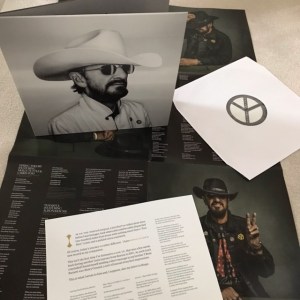
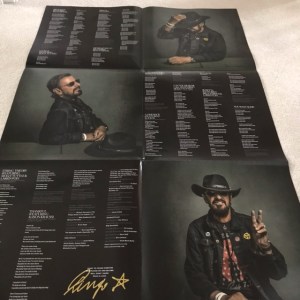
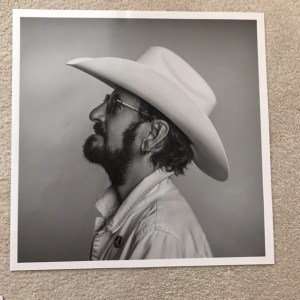
Just like the music behind the titles, the colour is all inside. A glossy lyric sheet unfolds to an A2 poster with another photograph of Ringo, this one posed: two fingers of peace held to the camera and a smile across his mouth that you’ll be sharing by now. The stars, on his shirt and all-over the album, suggest a better version of America than the one we have. It’s a hopeful image in so many ways.
And, importantly, Ringo’s collaborators are given due credit and a message of thanks: ‘I want to thank everyone who played on this record. Well done T Bone! Peace & Love.’

Ringo’s Round-up
Anytime I drop the needle on a new Fab release, there’s a knot where my stomach resided only seconds earlier – equal parts excitement and nerves. I just want it to be good. I don’t need anything ground breaking; Revolver’s still got that covered. I don’t need anything aspirational; Sgt. Pepper stands alone. I don’t need anything as expansive as All Things Must Pass or as eclectic as Ram or as political as Some Time In New York City or as glitzy as Sentimental Journey. I just want something that doesn’t affect the legitimacy of the existing canon. Something passable. I had the same feeling with McCartney III. And, strangely, Look Up elicited a similar response in me which is growing stronger with every spin.

The lyrics aren’t ground-breaking, the musical ideas aren’t exactly aspirational, the song structure isn’t eclectic, the running time at 36:57 isn’t expansive, other than the inescapable notion of America, it’s not a political album, and the artwork – although tasteful – isn’t particularly glitzy. But all of that’s also its biggest draw. It’s unfussy, confident, tasteful and relevant. It maintains a stylistic identity which holds, without resorting to parody. The lack of fade-outs, consistent use of instrumentation and just the right amount of imperfection make Look Up feel like a live band playing a set from start to finish: a running order with a sunrise-to-sunset arc, ending on Ringo’s heartfelt and positive message, wrought from a lifetime of experience.

The Beatles Handbook rating: 5 Stars
Essential tracks:
Look Up
Time On My Hands
Never Let Me Go
Rosetta
Thankful

P.S. as I was tidying up this article for publication, I was listening to Look Up on Spotify. After spending so long with the hard copy, I don’t remember a time when I’ve missed the tactility of vinyl as much. But streaming it offered a nugget of validation the vinyl could never: when the album finished playing and my Spotify algorithm side-stepped to a shuffle befitting what I’d just listened to, its first choice was ‘Loser’s Lounge’ from 1970’s Beaucoups of Blues. And it could’ve been cut from the same roll of studio tape. From Nashville to Nashville, 55 years apart, what a
vote of confidence. A gold star for Mr Starkey. 

Written by Jordan Frazer. Follow him on Twitter at @TheStylusMethod and find out more about the band at Bandcamp
Paul McCartney solo albums ranked: The 80s

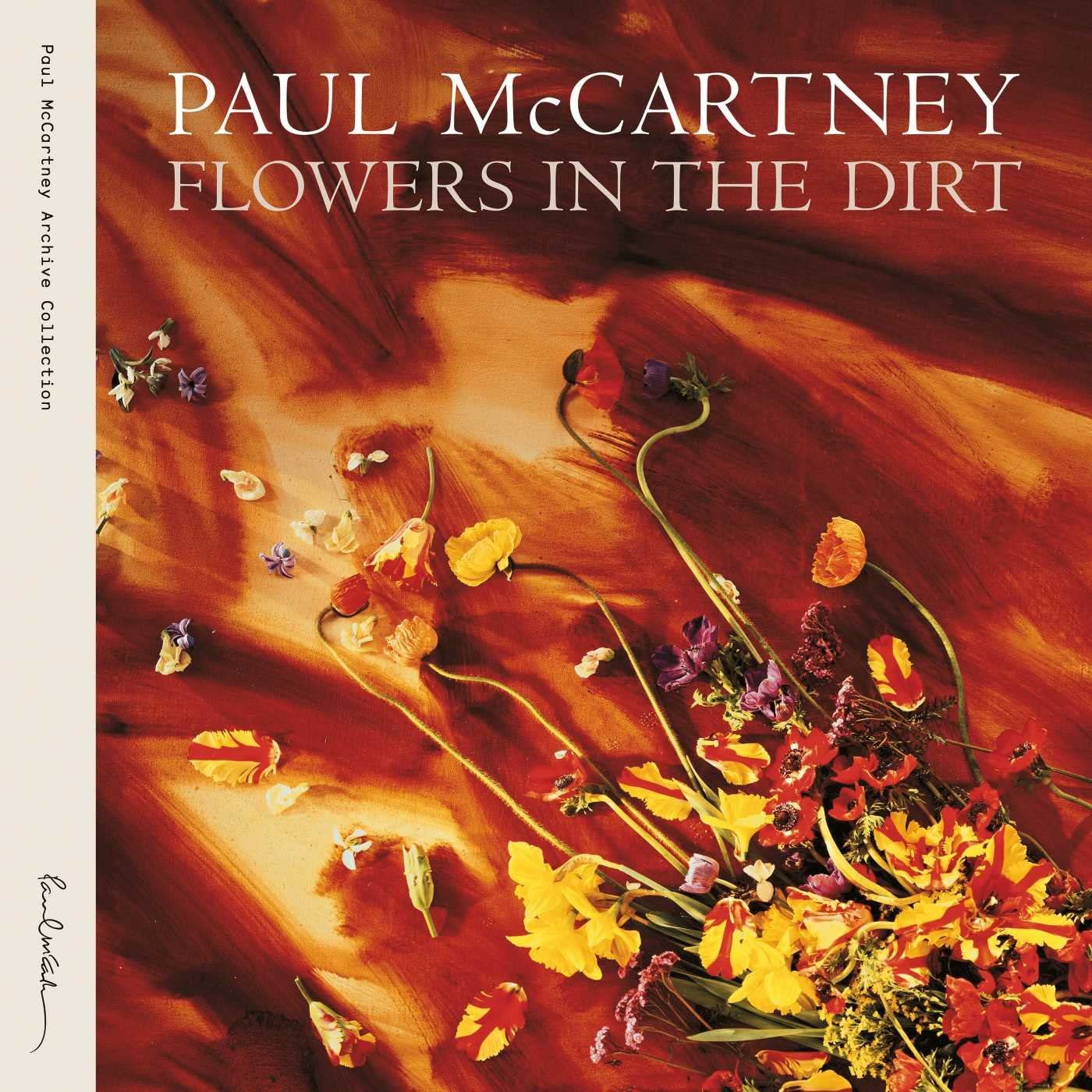
1. Flowers In The Dirt (1989)

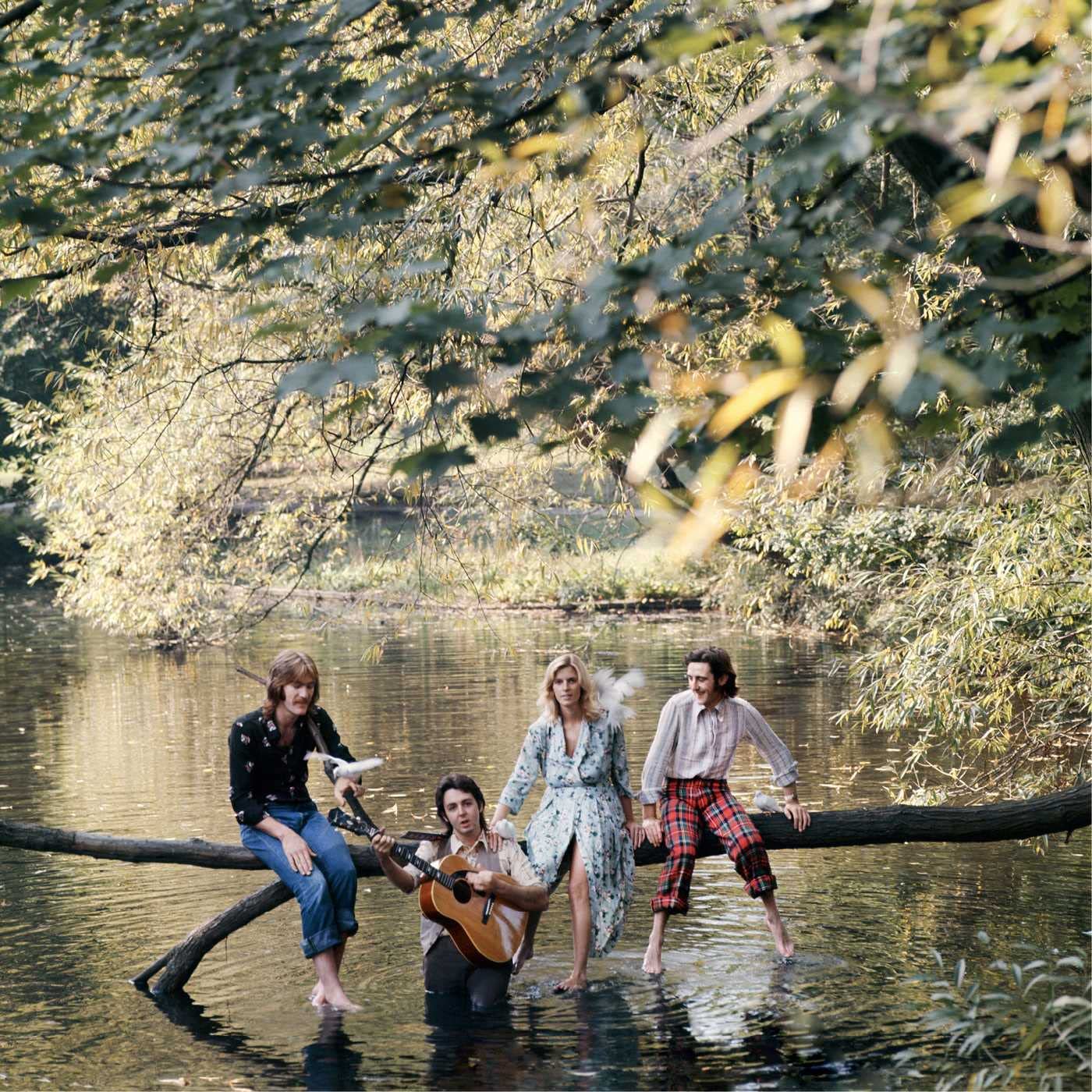
Flowers In The Paul McCartney

The 80s were a creatively fecund time for McCartney. In full magpie mode, he took inspiration from a variety of musical styles – the emerging electronica scene, funk, soul, folk and 50s rock and roll – and found either creative or commercial success (and sometimes both) with all of them, racking up 6 top 10 albums in the UK, 6 top 30 albums in the US, 11 top 10 singles in the UK (5 of them number 1s) and 6 top 10s in the US (including 3 number 1s).
But equally, the 80s were a testing time for Macca. As Jeff Slate noted in his 2017 Esquire article that coincided with the release of the Archive Collection edition of Flowers in the Dirt, the 80s saw, ‘a pot bust in Japan, the break-up of Wings, the assassination of John Lennon, a failed venture into filmmaking, a floundering recording career, public and private squabbling with George Harrison and Ringo Starr, and Michael Jackson buying the rights to his beloved Beatles songbook out from under him’.

With all that going on (although, given the above chart stats, I don’t agree that McCartney’s recording career was ‘floundering’) it’s no surprise that listening through McCartney’s 80s albums can be something of a chore. Despite some very high watermarks – ‘Waterfalls’, ‘Coming Up’, ‘Say Say Say’, ‘No More Lonely Nights’, ‘Here Today’, (and even the pomp-pop of ‘Tug of War’ and ‘Pipes of Peace’) – the albums can be typically characterised as extremely uneven with a few great tracks a piece and an awful lot of filler. McCartney II and the throwaway but fun Choba B CCCP are the partial exceptions that prove the rule.

In a 1987 NME interview, McCartney admitted ‘I’m superstitious. I think that if you stop, you might never come back’. Much of his 80s output sounds like McCartney writing and recording something, anything, simply to avoid stopping and disappearing into the pop void.

But all that changed with Flowers in the Dirt, the strongest McCartney album since At The Speed of Sound more than a decade earlier. In a filmed interview for Put It There: The Making of Flowers in the Dirt,  McCartney says the album’s consistent high quality is due ‘mainly ’cause we’re going out on tour, we kinda probably took a little bit more care over this one. I just don’t want to get stuck out in America somewhere on tour flogging an album that we don’t like.’

There was of course another reason. In 1987, McCartney began a short-lived writing partnership with Elvis Costello that, given the results on Flowers, reinvigorated McCartney’s creativity. McCartney himself compared the collaboration to his partnership with Lennon; a huge compliment. Costello’s raw and radical vision for the record was at odds with McCartney’s desire to make a more polished product and so only four co-writes made it on to the album (other tracks appeared over time on later McCartney and Costello solo records). But even if we were cheated on a complete album’s worth of material from the pair, what we do get is impressive.

The bold a cappella harmonies that open ‘My Brave Face’, and the album, are almost confrontational. McCartney seems to dare his critics to deny him the right to plunder his own musical legacy, with a nimble, melodic bass line played on that Höfner 500/1 as a bonus F.U.. It’s a tantalising taste of what The Beatles might have sounded like had they made it unscathed to the end of the 80s.

There’s more than a hint of Lennon and McCartney lyrical yin and yang about the memorable duet ‘You Want Her Too’. As McCartney pointed out in the NME interview ‘Elvis, he reminds me a little of John. Working with him is very similar. We wrote one song and thought ‘God, this is just like The Beatles’. There seems to be more of Costello’s dark edge in ‘Don’t Be Careless Love’, a sweet love song over which illogical anxiety casts its long shadow (‘Saw your body/rolled up in a rug/chopped into two little pieces/By some thug….But in the morning light…you’re by my side).

‘That Day Is Done’, written about the passing of Costello’s maternal grandmother, is the album’s emotional centrepiece. He told Esquire magazine that it ‘just came tumbling out in a lot of dense images that were very vivid and real to me, but perhaps not so comprehensible to the listener. Paul did something very subtle but crucial in making that song pay off to a big, plain spoken chorus, after I’d piled up all of these lines in the verses, including the one that yielded the album’s title.’

Perhaps buoyed by such a productive partnership (the above mentioned re-issue is well worth investigating for additional songs including the ‘Lovers That Never Were’, ‘Tommy’s Coming Home’ and ‘Twenty Fine Fingers’ that are easily as good as the tracks that made it to the original release. For a full appraisal of the McCartney/Costello demos, this article at reclinernotes.com is excellent), McCartney’s solo writes are uniformly excellent. ‘Distractions’, ‘Figure of Eight’ and ‘We Got Married’ are all top drawer stuff. There is the bafflingly awful white man’s reggae of ‘Too Many People’, but that’s just part of the eternal mystery of McCartney; the man that can write something as sublimely strange and haunting as ‘House of Wax’, to take just one random example, is the same man that can compose awful dreck like ‘We All Stand Together’.  

It seems a shame that McCartney has never worked with Costello again given the quality of Flowers, but perhaps the echoes of Lennon and The Beatles were just a bit too strong for him. Given the breadth of his work in the 90s and beyond, with his classical compositions and his more experimental work with Youth as The Fireman, it seems McCartney had his sights fixed firmly on the future rather than looking back to the past.

Beatles Handbook rating: 5 stars

Essential tracks
My Brave Face
You Want her Too
That Day Is Done

Buy this album: Flowers in the Dirt 

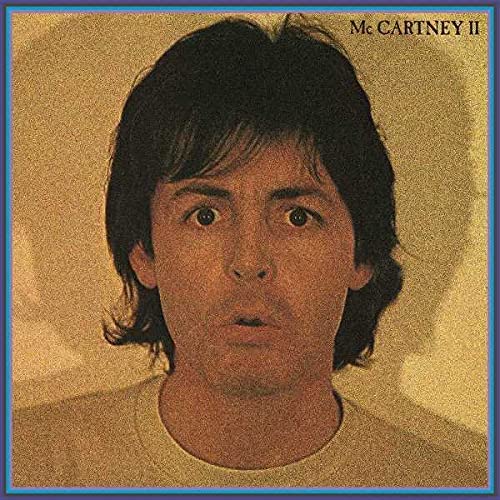
2. McCartney II (1980)
McCartney II

Echoing McCartney a decade earlier, McCartney II is a completely solo, home-recorded album that explores the possibilities offered by the then new-fangled technology of synthesisers and sequencers. Away from the band setting of Wings, which McCartney was becoming increasingly frustrated by, he seemed to relax and allow his creativity to flow. The results are delightful, if varied in quality (well, this is a Paul McCartney record after all). ‘Temporary Secretary’ sounds like your mad middle-aged uncle covering D.A.F., but in the best possible way; the unfortunately titled ‘Frozen Jap’ could be a Kraftwerk outtake, and ‘Front Parlour’ might be the electronic theme tune to a forgotten 80s children’s TV show.

‘Summer’s Day Song’, with it’s sweet melody,  sophisticated chord structure and minimalist synthetic arrangement is the bridge between the album’s purely electronic tracks and those with more traditional instrumentation and arrangement. Despite the presence of bass, drums and guitar, ‘Coming Up’ still manages to be a slightly batty fusion of four-to-the-floor funk and 1920s dance band horns; it remains an irresistibly unusual groove and an album highpoint, along with ‘Waterfalls’, one of McCartney’s most beautiful and tender love songs.

So, not a perfect record, but a huge amount of fun. The extended Archive Collection edition is also well worth exploring.

Beatles Handbook rating: 4 stars 

Essential tracks
Coming Up
Waterfalls
Temporary Secretary
Buy this album: McCartney II 

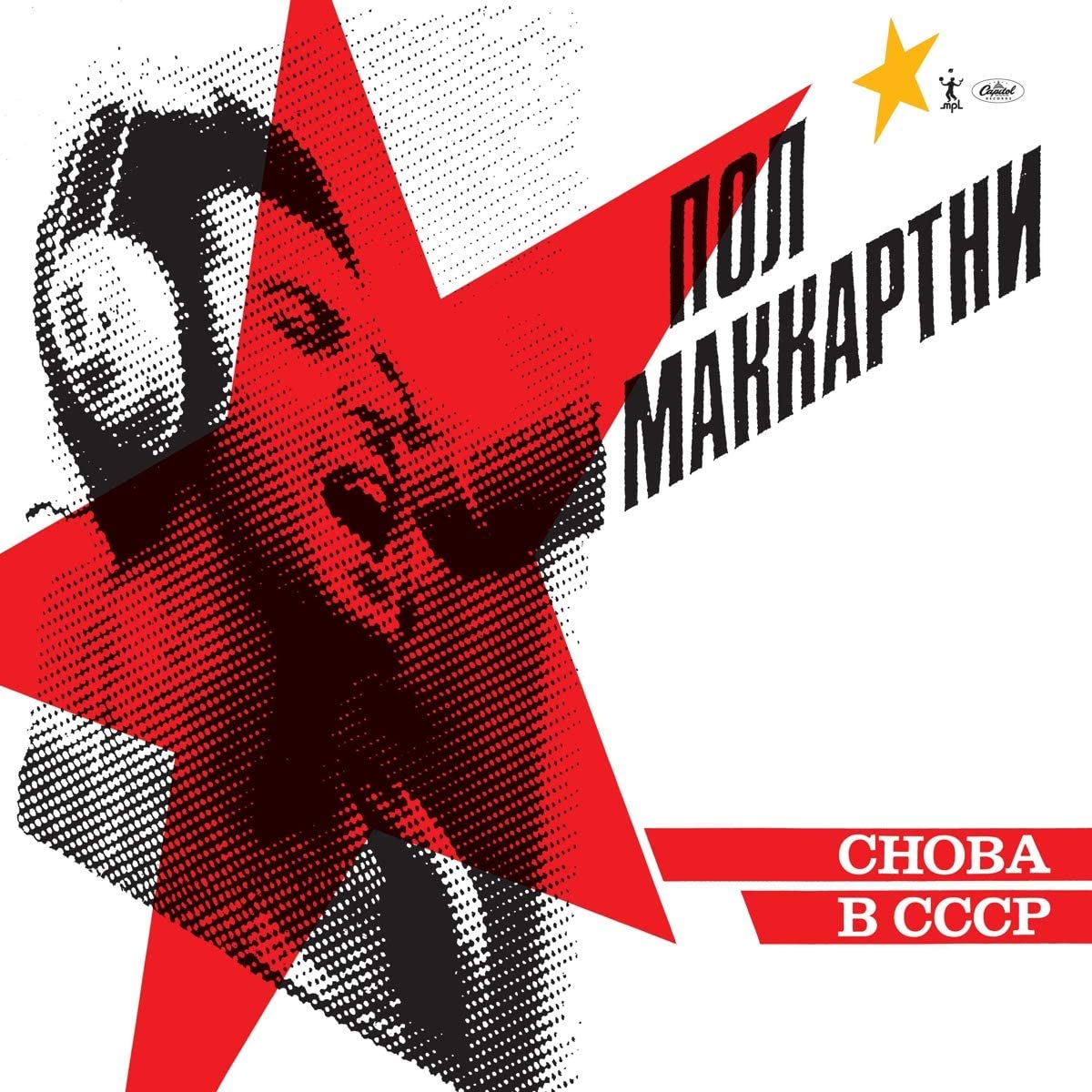
3. CHOBA B CCCP (1988)

CHOBA B CCCP

CHOBA B CCCP (‘Back In The USSR’) is stripped back palate cleanser after the production excesses of Press Play. Recorded live in the studio with a top band that included lauded Pirates guitarist Mick Green, Macca rattles through some rock’n’roll favourites and sounds like he is having a ball doing it. Not an essential album by any means, but in the the context of McCartney’s variable 80s output, a very welcome addition to the catalogue.

Beatles Handbook rating: 3 stars 

Essential tracks
Twenty Flight Rock
Lucille
Lawdy, Miss Clawdy
Buy this album: Choba B CCCP 

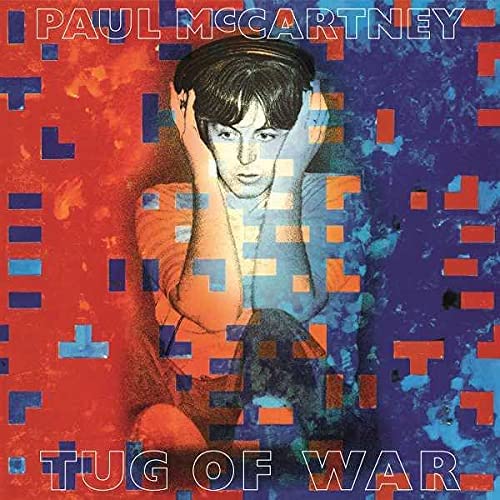
4. Tug Of War (1982)
Tug of War Paul McCartney

Recorded in the wake of Lennon’s death, Tug of War contains the moving tribute ‘Here Today’ to his former bandmate. Further Beatles connections in the form of George Martin’s production and Ringo Starr contributing drums and backing vocals on several tracks can save this from being an uneven and incoherent collection of songs. The almost endless personnel list includes everyone from Stanley Clarke and Steve Gadd to Andy Mackay and Carl Perkins (and Stevie Wonder of course) which reflects the album’s plethora of styles. The title track sounds much better now than it did at the time but still suffers a little from 80 bombast and grand statements, as well as some truly terrible lyrics and the unfortunate sub-high school English student rhyming of grumble/tumble/crumble.

The album also contains one of the worst songs ever composed in ‘Ebony and Ivory’. I’m sure some clever music critic somewhere has managed to argue its true artistic merits, but the reality is that this collaboration with Stevie Wonder is a mawkish and inane song with no redeeming features. Whereas the direct simplicity of ‘Silly Love Songs’ works wonderfully, taking a similarly naive  approach to race relations in ‘Ebony and Ivory’ results in one the worsts clunkers in the entire McCartney canon. Somehow, two of the finest musicians and songwriters of all time manage to cancel each other out. At least we have ‘What’s That You’re Doing’, an absolute belter of a funk/pop tune to show what they could achieve together.

‘Wanderlust’ apart (a gospel-influenced, soaring ballad with a nice brass arrangement), the album is dragged down by too much ballast in the form of forgettable pop ditties like ‘Take it Away’, ‘Somebody Who Cares’ and the horrible comedic um-pah of ‘Ballroom Dancing’.

McCartney is a hard worker, no one could dispute it. Seven albums (plus a movie) in one decade is ample evidence of that. But listening to Tug of War makes you wish he’d taken it a bit easier, recharged the old song writing batteries and come up with something just that bit better.

Beatles Handbook rating: 2 stars 

Essential tracks
Here Today
Tug Of War
What’s That You’re Doing
Buy this album: Tug of War 

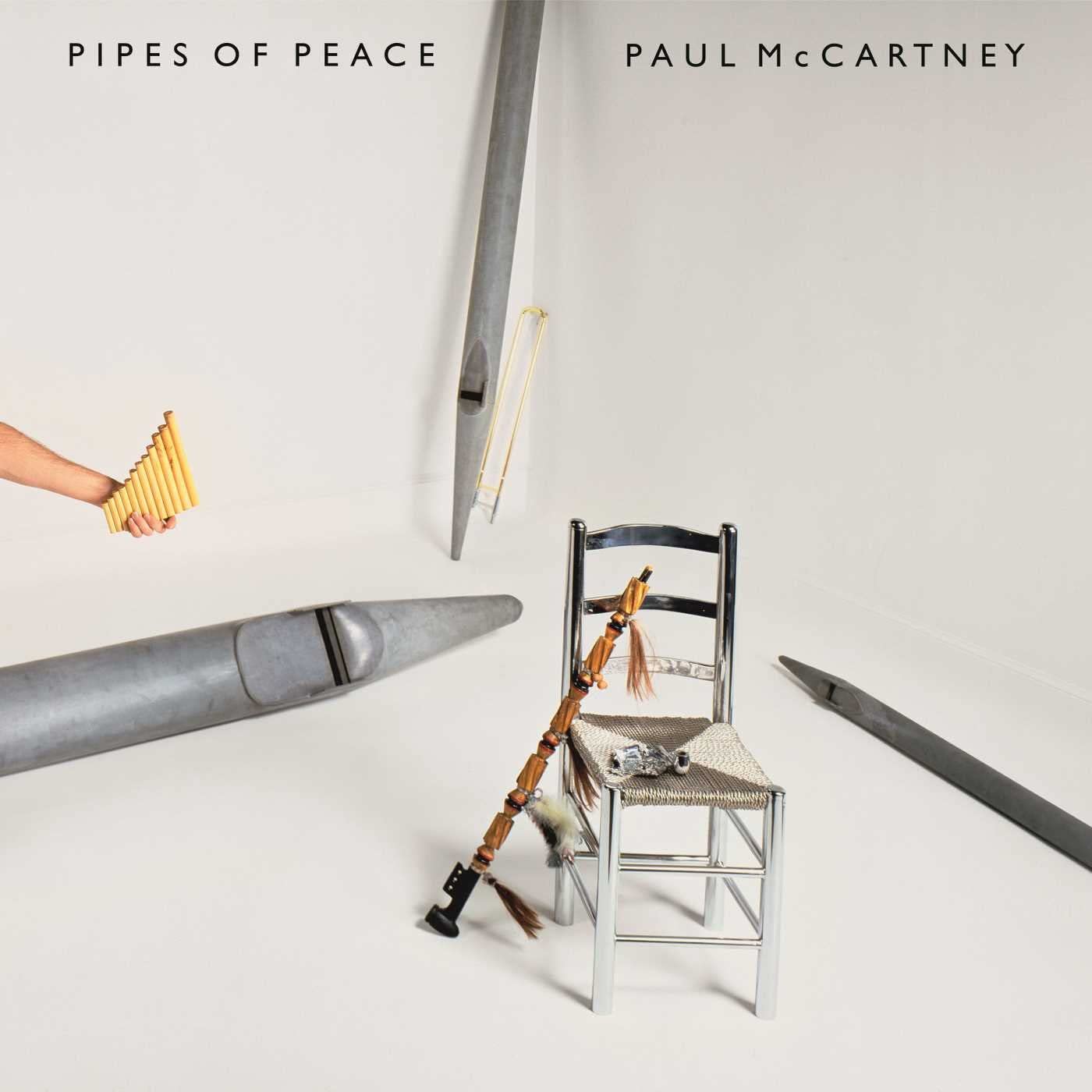
5. Pipes Of Peace (1983)
Pipes of Peace Paul McCartney

The title track is a finely crafted piece of catchy pop with some nice turns of phrase (‘Will the human race/be run in a day’) with a straightforward pacifist message. The remainder of the album is mostly made up of a vaguely pleasing wash of white pop/soul/funk (‘So Bad’ and ‘Through our Love’ are relative stand outs) that only catches fire when Michael Jackson gets involved; ‘Say Say Say’ is an enduring pop classic with an earworm of a melody and ‘The Man’ is just a great tune that features a sweet-as-honey Jackson vocal performance. With too many filler tracks like the disposable ‘Tug Of Peace’, it’s hard to imagine listening to the whole album through very often, if at all. 

Beatles Handbook rating: 2 stars 

Essential tracks
Say Say Say
The Man
Pipes Of Peace
Buy this album: Pipes of Peace 

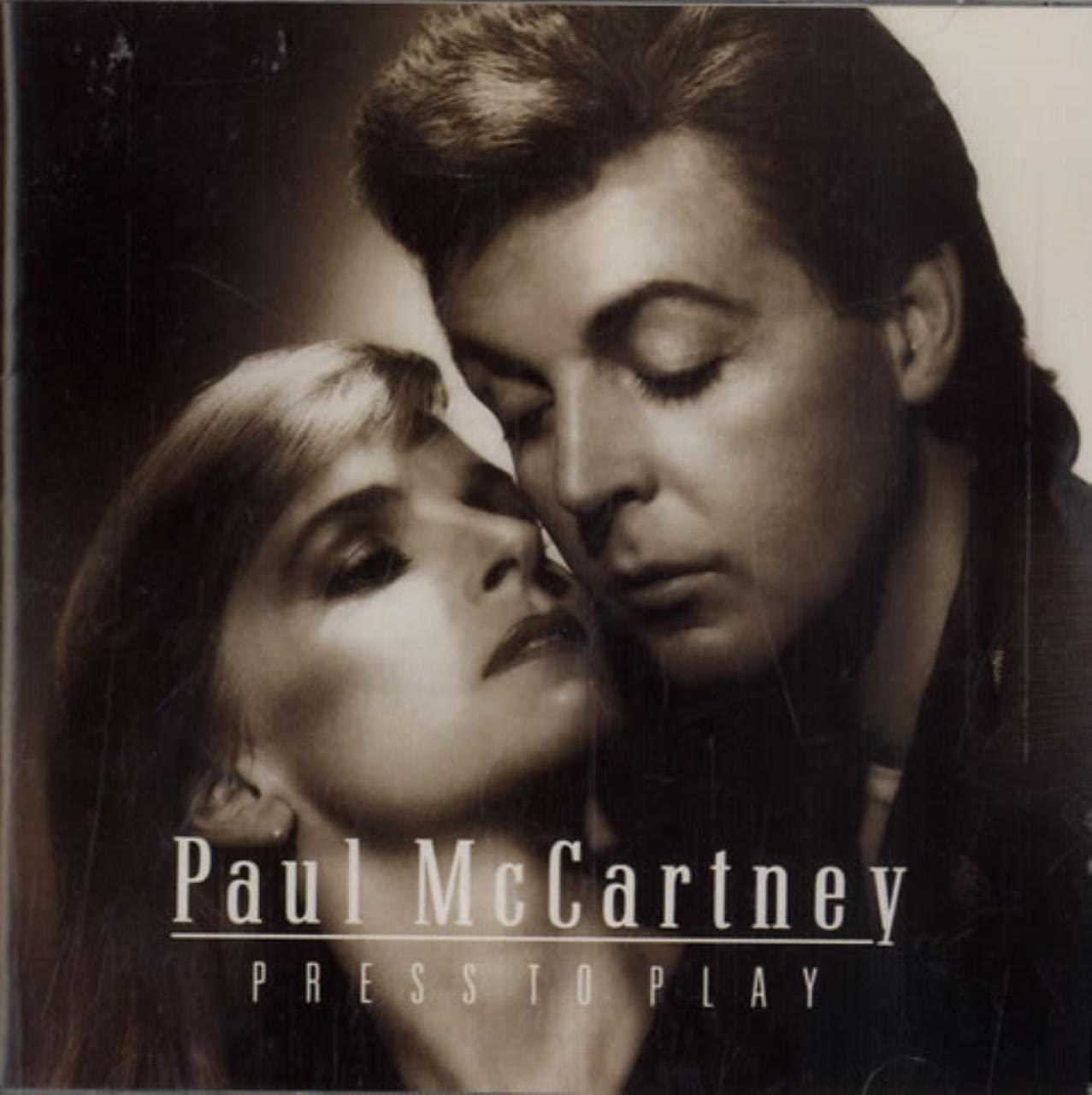
6. Press To Play (1986)
Press to Play by Paul McCartney

In which McCartney gets well and truly Hugh-Padgham-ed. A terribly dated, none-more-80s exercise in slick over-production. Unusually, McCartney seems to be relying on sound textures to create interest rather than solid song writing, despite help on a number of tracks from the estimable Eric Stewart.  The cod-reggae of ‘Good Times Coming’ is a low point, the perfect, shiny pop of ‘Press’ is a real high. The solo-penned ‘Only Love Remains’ is beautiful, a true McCartney classic love song.

Beatles Handbook rating: 2 stars

Essential tracks
Only Love Remains
Press
However Absurd
Buy this album: Press to Play 

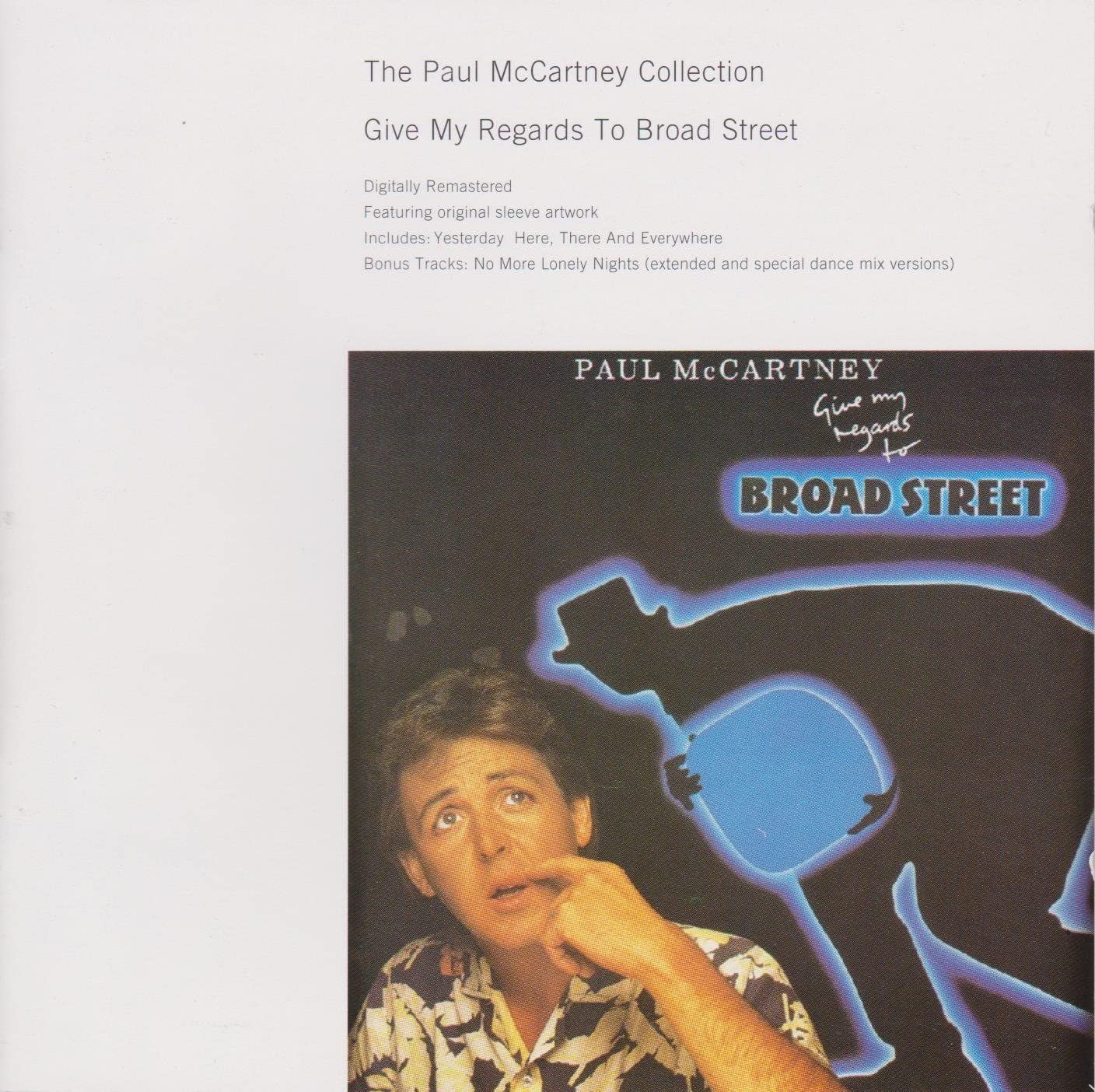
7. Give My Regards to Broad Street (1984)

Give My Regards To Broadstreet by Paul McCartney

The soundtrack to McCartney’s ill advised post-Beatles foray into major motion pictures is mostly composed of re-recordings of previously released Beatles and solo McCartney songs. It’s a rum old mix, with stone cold classics like ‘Here There and Everywhere’ rubbing shoulders with lesser McCartney compositions such as ‘Ballroom Dancing’. The only new tracks on the album are the the excellent pop ballad ‘No More Lonely Nights’ (one of McCartney’s best) the average, mild mannered rocker ‘Not Such a Bad Boy’ and the faux-punk ‘No Values’ (*shrugs*). There’s an extended  symphonic reworking of ‘Eleanor Rigby’ called ‘Eleanor’s Dream’, which is certainly interesting but hardly essential. McCartney completists will want an updated ‘Yesterday’ (even if it does sound very similar to the original) but others need not apply.

Beatles Handbook rating: 1 star

Essential tracks
No More Lonely Nights
Buy this album: Give My Regards To Broad Street

George Harrison Solo Albums Ranked

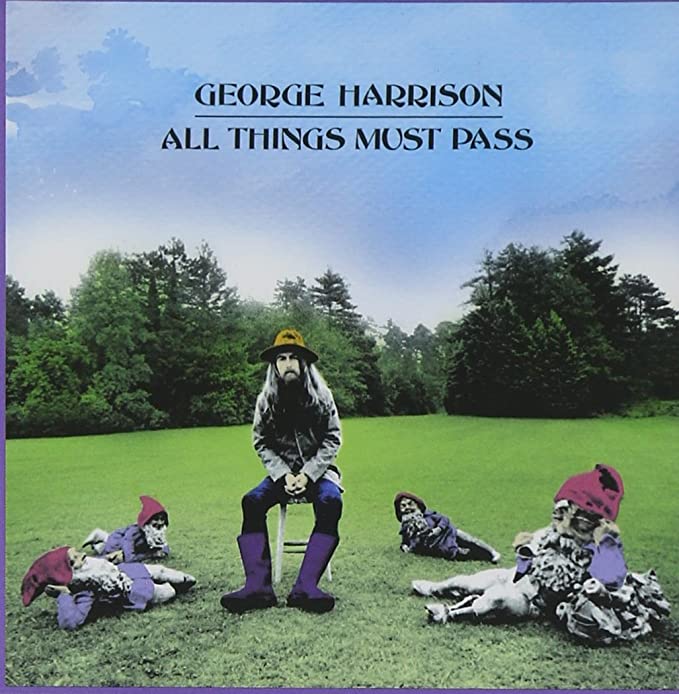
1. All Things Must Pass
All Things Must Pass George Harrison

Here comes little Georgie Harrison with a great big statement of a triple album set. He’s got his two albums worth of weirdo electronica experimentation out of his system since The Beatles finished and he’s ready to lay down all those songs Paul and John turned their nose up at.  And what songs they are. All that pent up frustration that was made so clearly visible in the Get Back footage is unleashed to magnificent and enduring effect.  All Things Must Pass is not just George Harrison’s finest solo album, it’s the best solo album ever recorded by a Beatle, and ‘All Things Must Pass’ is the finest solo Beatle song.

Harrison assembled a who’s who of rock to make the record, including Ringo, Billy Preston, Eric Clapton (and the rest of his alter ego band Derek and Dominos: Bobby Whitlock on keyboards, Jim Gordon on drums and Carl Radle on bass), Peter Frampton and Ginger Baker among many others. It was produced by Phil Spector and the opening track  ‘I’d have You Anytime’ was co-written with Bob Dylan.

The set’s 23 tracks run the gamut from rock and R&B to gospel, country and folk. While it is a sprawling collection, there is a cohesiveness to it that makes listening to all six sides (or streaming it in its entirety) a real joy. Are the final two sides of jams essential? Well, maybe not, but they have enough energy and invention to make them enjoyable. I for one would miss them if they weren’t there.

It’s hardly going out on a limb to call All Things Must Pass a masterpiece. It has been included in countless best albums lists including Rolling Stone magazine’s 500 Greatest Albums of All Time best albums of all time, and in 2014 All Things Must Pass was inducted into the Grammy Hall of Fame. Nevertheless, it’s worth reiterating what an outstanding achievement this is in the annals of The Beatles

Essential tracks
All Things Must Pass
My Sweet Lord
Beware of Darkness
What Is Life
Wah-Wah
If Not For You
Beatles Handbook rating: 5 Stars
Buy this album: All Things Must Pass

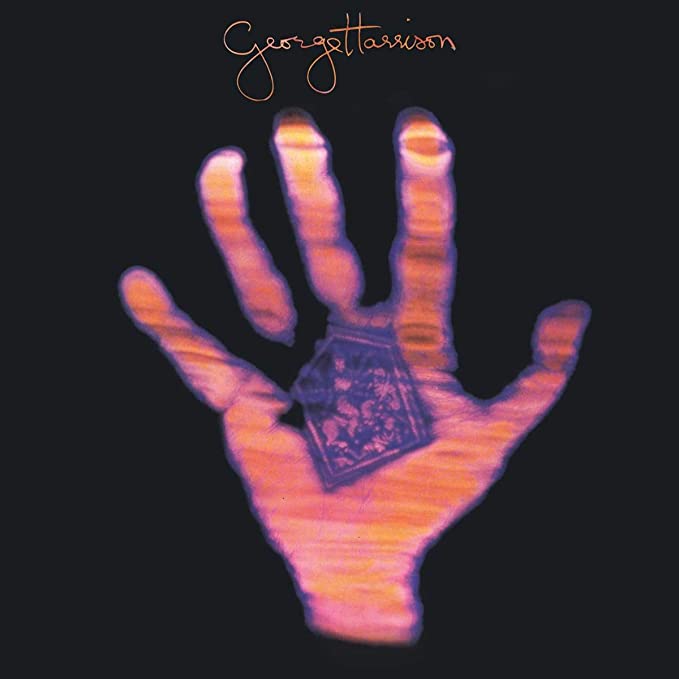
2. Living in the Material World
Living in the Material World George Harrison

After completely emptying the tank for All Things Must Pass, Harrison struggled to follow it up, proving it was a one-off, solely fuelled by his backlog of Beatle’s cast offs, right? Wrong. Living in the Material World might be less ambitious than All Things, as a single album with far fewer contributors and a more narrow and concentrated musical style, but it’s a very strong successor that proves Harrison’s song writing skills and melodic ear were every bit as honed as McCartney’s or Lennon’s.

Let’s overlook the clunker that is ‘Sue Me, Sue You Blues’ (Harrison in full mithering mode, bemoaning his legal costs in the wake of the Beatles break up – someone really should have said something to him) and instead concentrate on all the wonderful, spiritually charged music the album otherwise contains. There is strong competition for most-beautiful-Harrison-composition in the form of the yearning ‘Who Can See It’ and elegiac ‘The Light That Has Lighted The World’, but the winner must be ‘Be Here Now’ with an elegantly sparse arrangement that highlights Harrison’s mesmerising guitar playing and heartfelt, lilting vocal.

But ‘Be Here Now’ might not even be the best track on the album, such is the consistent quality of Harrison’s writing and performing. ‘The Day The World Get ‘Round’ has a stronger hook, ‘Try Some Buy Some’ a slightly heftier emotional punch. ‘Living In The Material World’ is an earworm of a pop hit and ‘Give Me Love (Give Me Peace on Earth) with it’s soothing slide guitar, is a gentle stroll through a sun dappled meadow with a loved one.

So, Living In The Material World doesn’t quite reach the dizzying height of All Things, but then very little in the rock and pop canon has. It does however further establish Harrison as an all time great recording artist in his own right outside of his work with his old band. An absolute delight and one to be cherished.

Essential tracks
Give Me Love
Be Here Now
Living In The Material World
Beatles Handbook rating: 4 Stars
Buy this album: Living in the Material World

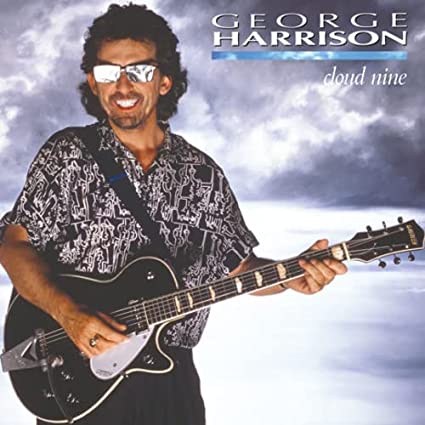
3. Cloud Nine
Cloud Nine George Harrison

A fine, vital return after a 5 year break. Harrison is eased into the late 80s high production-value  pop/rock area by Jeff Lynne’s steady production hand. From the taught blues funk of the opening title track to the pop joy that is ‘Got My Mind Set On You’ (a cover of Ruby Clark’s 1962 song), Cloufn Nine is a blast. Why no modern boy band has covered ‘That’s What It Takes’ is a mystery.

Given that uber-Beatles fan Lynne is at the helm, it’s no surprise to find some nods, overt or otherwise, to Harrison’s old muckers. ‘When We Was Fab’ is indeed fab, with its oblique, sarky lyrics and musical Beatles quotes including ‘I Am The Walrus’ and ‘Within You Without You’. The video, featuring Ringo Starr is a proper hoot too. And I swear there is more than a hint of Lennonesque rasp to the vocal ‘Fish On the Sand’.


Although Cloud Nine lacks the spiritual heft of All Things and Living (‘Just For Today’ is however a touching lament that wouldn’t be out of place on the latter album), it succeeds completely on its own terms as a meticulously engineered, gleaming pop/rock artifact. ‘Devil’s Radio’ is something of a Tom Petty-alike throwaway rocker and ‘Wreck of The Hesperus’ is similarly lightweight, but both are well constructed and enjoyable, you wouldn’t skip them on a listen through.

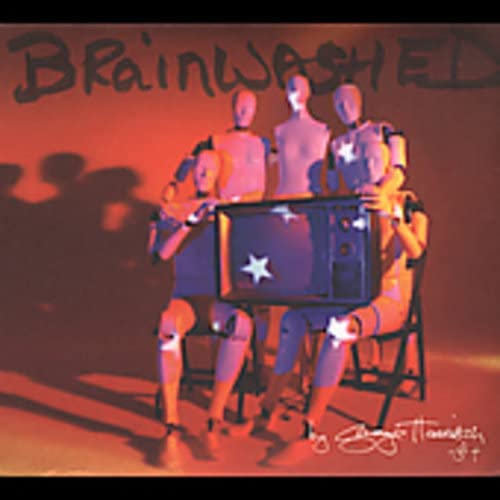
As the last album released during Harrison’s lifetime, it’s a fitting finale (Brainwashed, released in 2002 was completed by Harrison’s son a year after Harrison’s death) with Harrison on top form again in all departments and embracing the future while slyly looking back to his illustrious past.

Essential tracks
Got My Mind Set On You
When We Was Fab
That’s What It Takes
Beatles Handbook rating: 4 Stars
Buy this album: Cloud Nine

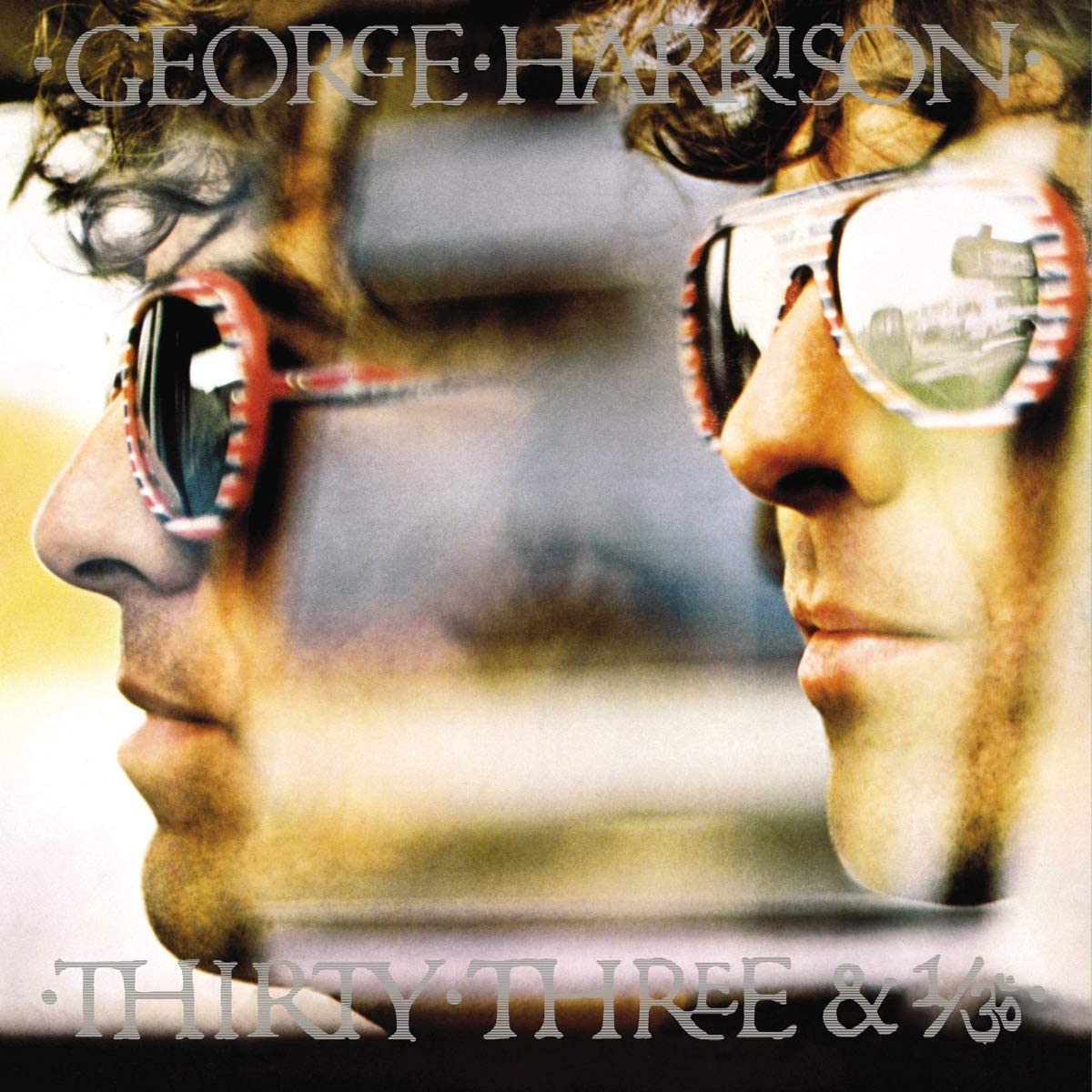
4. Thirty Three & 1/3
Thirty Three And A Third George Harrison

A very strong collection of tunes including the slap bass-driven Woman Don’t Cry For Me, the sublime white soul of Pure Smokey and the addictive pop hook of Crackerbox Palace.

Essential tracks
Crackerbox Palace
Woman Don’t You Cry For Me
Beautiful Girl
Beatles Handbook rating: 4 Stars
Buy this album: Thirty Three & 1/3

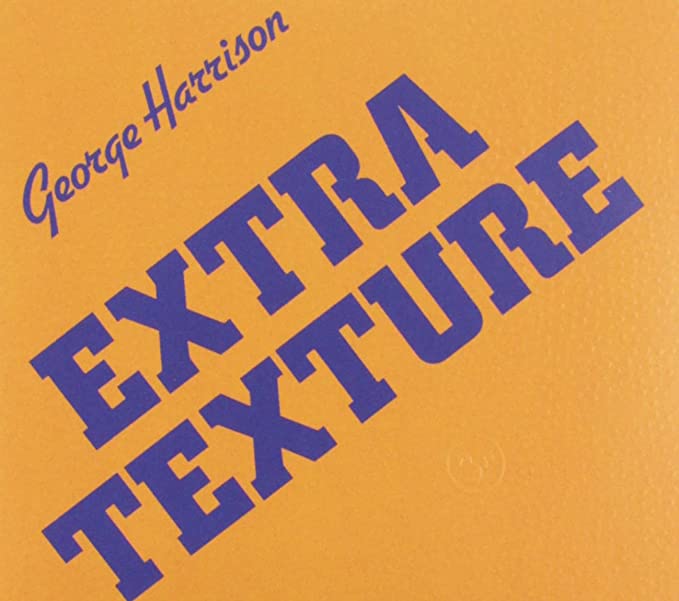
5. Extra Texture
Extra Texture George Harrison

From the opening euphoric, sax-driven blast of pop joy ‘You’ to the closing surreal-rocker ‘His Name is Legs’, an album of varied delights.

Essential tracks
You
This Guitar (Can’t Keep From Crying)
His Name is Legs (Ladies and Gentlemen)
Beatles Handbook rating: 4 Stars
Buy this album: Extra Texture

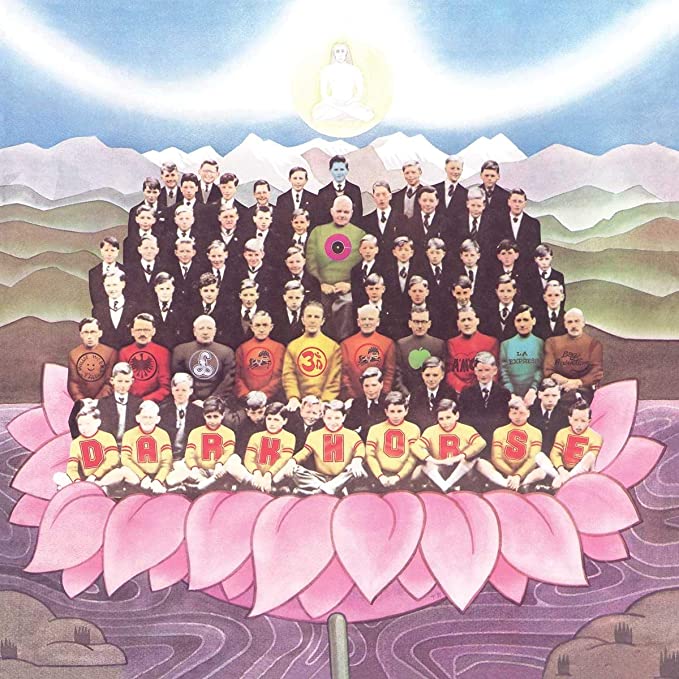
6. Dark Horse
Dark Horse by George Harrison

Memorable tunes and a successful mix of guitar-led pop ballads and white boy soul stylings make for a great album. The festive Ding Dong, Ding Dong is a Wizzard-style Christmas knees up.

Essential tracks
Dark Horse
So Sad
Far East Man
Beatles Handbook rating: 4 Stars
Buy this album: Dark Horse

7. Brainwashed
Brainwashed George Harrison

Recorded in the late 80s and 90s and finished following Harrison’s death in 2001 by his son Dhani and Jeff Lynne. A strong coherent collection with ‘Stuck Inside A Cloud’ a plaintive highlight.

Essential tracks
Stuck Inside a Cloud
Brainwashed

Looking For My Life
Beatles Handbook rating: 4 Stars
Buy this album: Brainwashed

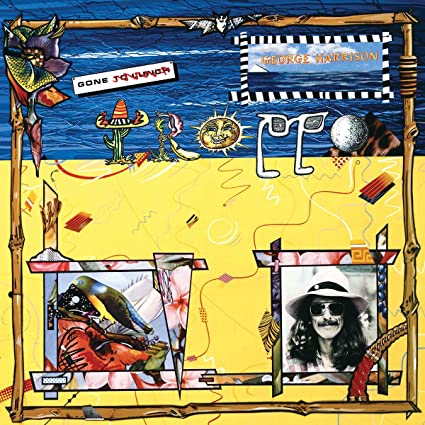
8. Gone Troppo
Gone Troppo George Harrison

Bookended by the rousing pop of ‘Wake Up My Love’ and the haunting, mournful ‘Circles’, the album sags badly in the middle, despite a gleeful cover of doo-wop classic I Really Love You.

Essential tracks
Wake Up My Love
Circles
I Really Love You
Beatles Handbook rating: 3 Stars
Buy this album: Gone Troppo

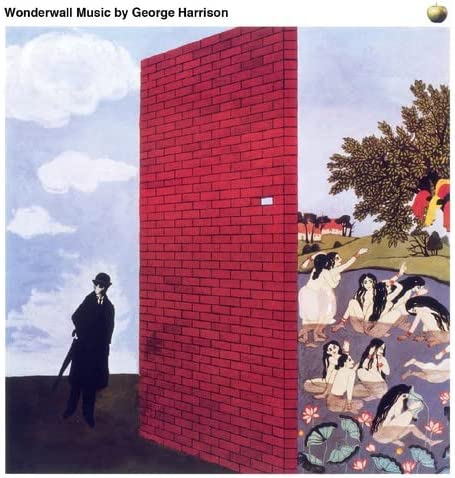
9. Wonderwall Music
Wonderwall Music by George Harrison

The first ever Beatles solo album is the all instrumental soundtrack to a psychedelic film starring Jane Birkin that incorporates classical Indian music. An interesting curio.

Essential tracks
Red Lady Too
Wonderwall To Be Here
Party Seacombe

Beatles Handbook rating: 3 Stars
Buy this album: Wonderwall Music

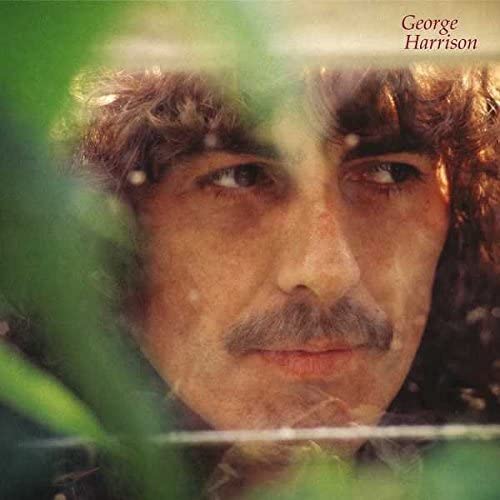
10. George Harrison
George Harrison

‘Here Comes the Moon’ is an interesting yin to ‘Here Comes the Sun”s yang, but otherwise a fairly ropey record, epitomised by the awful F1-themed ‘Faster’

Essential tracks
Love To Everyone
Here Comes the Moon
Not Guilty

Beatles Handbook rating: 3 Stars
Buy this album: George Harrison

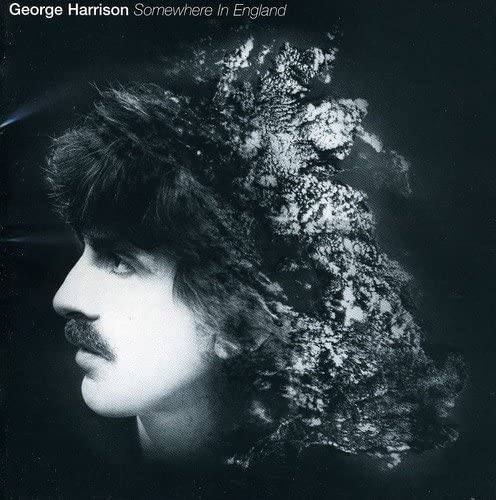
11. Somewhere in England
Somewhere in England George Harrison

A lacklustre and uninspired album compounded by weedy production. Only the jaunty pop of Teardrops and the sombre drama of Baltimore Oriole make an impression.

Essential tracks
Teardrops
Baltimore Oriole

Beatles Handbook rating: 2 Stars
Buy this album: Somewhere in England

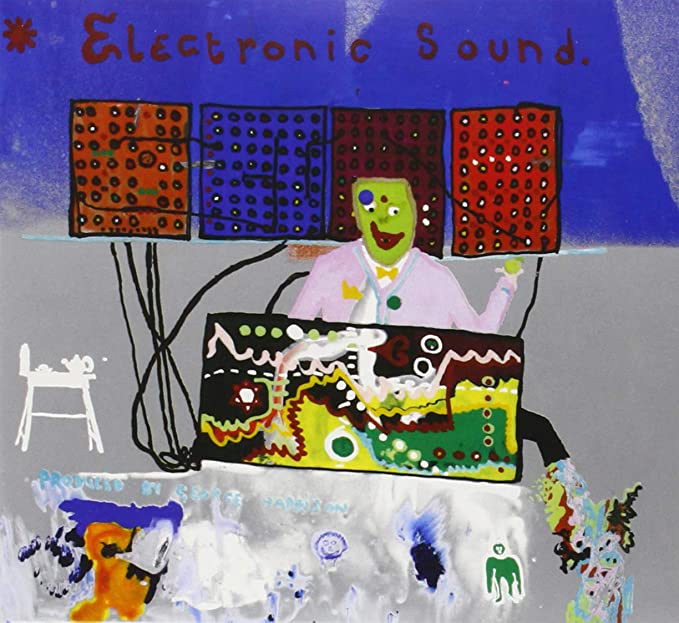
12. Electronic Sound
Electronic Sound George Harrison

Two 20 minute tracks of patience-testing synth noodling. I’d love to know how many other people have actually listened to the whole thing. Zero fun.
Essential tracks
None
Beatles Handbook rating: 1 Star
Buy this album: Electronic Sound

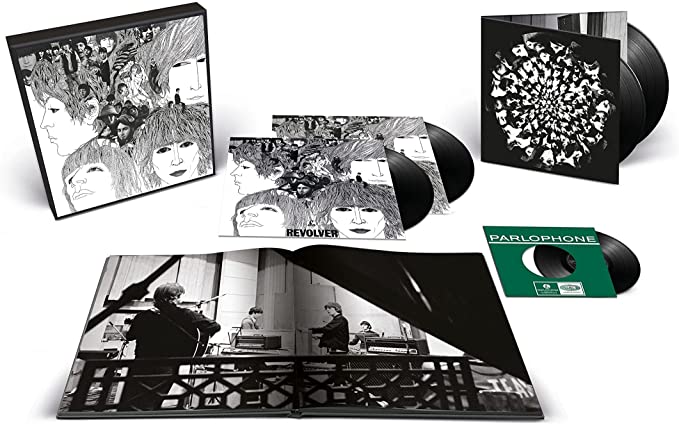
Review: Revolver Super Deluxe Vinyl Box Set

Revolver super deluxe vinyl
I [pretentious cough] ‘discovered’ The Beatles in the mid-2000s, aged 13. I began like so many others with the Red and Blue albums, but where to go next? Back then the adage that Sgt. Pepper’s Lonely Hearts Club Band was the greatest thing ever committed to record had largely eroded and been replaced by men-of-a-certain-age advocating for Revolver as the true rock masterpiece, so that’s where I headed.

Revolver. What is that? A pun? I spent hours staring at the artwork. Why are the boys out of order? (Paul, John, Ringo and George) Why are three of them looking away? Why, in a technicolour age is Klaus Voorman’s cover design in monochrome? And then there’s the tracklisting; the song titles are weird. Why doesn’t ‘Love You To’ make grammatical sense? Who is ‘Dr Robert’? What else, besides sing, can your bird do? What on earth (or any other planet) does ‘Tomorrow Never Knows’ mean? What, exactly, has Paul got to get into his life? George has three songs on this one; what the bloody hell? Is it even George on the back cover or is it three Beatles and Keith Richards? I hadn’t yet pressed play on the first track and already my little head was filled with things to say. A portable disc player and some over the ear headphones. I was alone, I took a ride, I didn’t know what I would find there.

What I found when I pressed play was finger snaps, tape loops, wild horns, backwards melodies, searing harmonies, drones, twin-lead guitars, clavichords, changing time signatures, fade-ins and fade-outs. I found the gruff nonchalance of the ‘Taxman’ count-in and the disconcerting semitone piano riff in ‘I Want To Tell You’. The delicate beauty of ‘Here, There And Everywhere’, the thunderous trance monotony of the ‘Tomorrow Never Knows’ rhythm section and the austere greyness of ‘Eleanor Rigby’. When the most perfect five-second guitar break in ‘Got To Get You Into My Life’ bursts the black and white bubble and lets the colour in, it’s like Bobby Moore lifting the Jules Rimet trophy.

Revolver is the most eclectic Beatles album. It’s the most ambitious and it’s the most fun. Not once is an idea repeated and, listening in order, you can hear the expansion of 20th Century popular music with every note, inspiring future artists across genres to pick up guitars, sit at pianos and evoke the sound of the Dalai Lama chanting on a mountain-top. Well, maybe.

But this article is not about Revolver, the album. It’s about Revolver, the 2022 Super Deluxe Box-Set, for which my adoring family handed over the £189.99 (plus delivery) for my 29th birthday present. Vinyl is my chosen medium these days and the excitement of holding in my hands the ‘new’ version of the album I’d loved for 16 years was palpable.

The New Stereo Mix
Despite the temptation to skip ahead to the studio outtakes, I behaved myself. The changes here are slight but fantastic. This is not a dusting-off or a face-lift. This is more like a leg-up over the wall into the chocolate factory, a gentle nudge into the 21st Century for something that will live forever. With the exception of ‘She Said She Said’ (on which the rhythm guitar on the left channel is a little intrusive), the new stereo mixes are invariably better than the 2009 re-masters.

This is a crisper, punchier sound. It’s more metallic in just the right places, like Paul’s raga-inflected solo in ‘Taxman’ and John’s acoustic strums in ‘I’m Only Sleeping’. It’s also warmer in others, like George’s lush harmonies, Ringo’s fills in ‘Here There And Everywhere’ and the sound effects in ‘Yellow Submarine’, transporting you to Studio No.2 with bathtubs and chains, Mal Evans’ hosepipe, Brian Jones clinking glassware and George Martin wearing brass instruments for hats. You can hear the fun that was had; how amazing that sound can convey that.

For a collection of songs so familiar to its listeners, there are things you’d maybe never noticed before. In at least two places, John and Paul sing ‘Bob Robert’ rather than ‘Dr Robert’ and Ringo does indeed play on ‘For No One’! The final chorus on ‘Good Day Sunshine’ is more pronounced before its fade-out and Paul’s yawn in the middle of ‘I’m Only Sleeping’ sounds like he’s waking-up right next to you. ‘Love You To’ sounds more authentically Indian than ever and for the first time becomes one of the stand-out tracks on the album.

Maybe it’s because of the sequencing or simply because Side One is so strong, but it always felt like the section after ‘Good Day Sunshine’ and before ‘Got To Get You Into My Life’ was overlooked. This is where the 2022 stereo mixes shine. The guitar work in ‘And Your Bird Can Sing’, the vocal agility and sympathetic percussion in ‘For No One’, the whirring guitars and Paul’s harmony line on ‘he’s a man, you must believe’ in ‘Dr Robert’ and the interplay between George’s guitar riff and Ringo’s drums in ‘I Want To Tell You’ are the highlights of the new stereo mixes.

Sessions
Even the Beatles fanatics among us who aren’t in constant search of bootlegs have heard some of this material before on Anthology 2 including take 1 of ‘Tomorrow Never Knows’, the hornless version of ‘Got To Get You Into My Life’, the how-many-words-can-we-get-into-the-backing-vocal version of ‘Taxman’ and the high-as-kites giggling breakdown of ‘And Your Bird Can Sing’, perhaps more appropriately titled ‘And Your Byrds Can Sing’. It’s the material we haven’t heard before that brings the magic to this collection and there’s a lot to pore over on these four sides.

Rain Take 5 – Actual speed
The song that invented Oasis was recorded in A and then slowed down to G. That version is impressive enough; Ringo’s finest moment on record with a drum part so unusual and busy that it gives the impression it might fall apart at any time, the rest of the song crumbling around it. Paul’s rumbling bass threatens to toss the needle out of its groove. But it’s even more jaw-dropping when you hear the rhythm track at its original speed. An oft-advanced criticism of these previously-unreleased studio tapes is that seeing behind the curtain ruins the illusion. This recording is that most rare example of learning more of how something was created posing further questions and a greater sense of awe. How did they play it at this speed and keep it so tight? Has a band ever sounded that good again?

Got To Get You Into My Life (First version) – Take 8
Paul is the most musically-gifted Beatle and, at the time of recording Revolver, the hippest and most adventurous of the four. It’s rather funny, therefore, to hear his apparent confusion at the idea to fade-in the organ:

Paul: ‘I don’t see how you’ll get any different sound from that’ [hits opening chord]
John: ‘You’ll get the organ but without the start of it’
Paul: ‘Why though?’ (See the photograph of Paul on page 6 of the accompanying book as a perfect companion piece to this quote).

Whether we’d admit it or not, we all want to be in The Beatles’ inner circle and, post-Get Back, these studio chatter clips make you feel like you’re in the room. Imagine that.

Yellow Submarine (Songwriting Work Tapes)
‘Yellow Submarine’ is relentlessly relied on by bores, music snobs and other Blue Meanies as hard evidence that (a) The Beatles are overrated and (b) Ringo is crap. Fortunately, I no longer feel the need to challenge such opinions. Is it musically complex? No, but we have ‘Here, There And Everywhere’ for that. Does it have the best vocal? No, but we have ‘I’m Only Sleeping’ for that. Does it challenge us as listeners? Well, now you mention it…

In Paul’s foreword he writes ‘…one twilight evening, lying in bed before dozing off, I came up with a song that I thought would suit Ringo and at the same time incorporate the heady vibes of the time, ‘Yellow Submarine”. This was certainly my understanding of its genesis. Children’s song. Written by Paul. Sung by Ringo.
However, this seems at odds with the two ‘Songwriting work tape’ versions of the song on side four of the Sessions discs. ‘In the place where I was born, no one cared, no one cared’ sings John, on a recording reminiscent of the earliest versions of ‘Strawberry Fields Forever’. A John song after all? What is perhaps more interesting is the following track. John sings the revised lyrics, beginning ‘In the town where I was born lived a man who sailed to sea’ after Paul’s encouragement that ‘…you know how to sing it’.

It’s impossible not to see these lines as a description of Alf Lennon. If that’s correct, then this is John at Plastic Ono Band levels of vulnerability and very far from the eventual Goons-like feel of the released version. That is not, of course, to say that Paul (and yes, okay, Donovan who contributed the lines ‘sky of blue, sea of green’ to the final version of the lyrics) didn’t write some, or even most of the remaining lyrics, but this is truly a revelation which challenges one little piece of the accepted narrative of ‘The Beatles’.

Tomorrow Never Knows – Take 1 & I Want To Tell You – Speech & Take 4
The album’s psychedelic closer was a turning point for a band for whom every album presented a turning point. If given its original name, ‘The Void’, it would be all too much. Tempered by the Ringo malapropism title and now also by John’s music-hall ‘da da da’ ending (which was left off the Anthology 2 version), we’re reminded that at almost no time ever did The Beatles take themselves seriously, and neither should we.

Similarly, a comedy highlight of the Sessions is John’s suggestion that George’s as-yet-untitled ‘I Want To Tell You’ should be named ‘Granny Smith part friggin’ two’. A reference to the working title of ‘Love You To’ being ‘Granny Smith’, this self-referential Beatle humour is just what we were hoping for. The actual working title for this song ended up as ‘Laxton’s Superb’.

Eleanor Rigby Speech before Take 2
This fragment reflects so much of what the band and their story is all about. On the studio floor, professional classically-trained musicians with cut-glass accents discuss the virtues (or otherwise) of using vibrato on the string quartet accompaniment to ‘Eleanor Rigby’ while the learned-RP voice of George Martin acts as translator. Up above them, by about 20 stairs, paying half-attention is the not quite 24-year old working class creator, James Paul McCartney. Could he tell a difference between the two takes? ‘Err, not much’. The student becoming the master.

This is a reminder of two things – first, that the creative boom of the 1960s relied on a disruption of the class system in Britain. Second, that The Beatles needed and welcomed collaborators, the most essential of whom was George Martin.

The Other Bits
The Super Deluxe box also includes:
an LP of the original mono master, still sounding glorious on 12-inch vinyl and a good comparator for the new stereo mixes; a ‘Paperback Writer’ c/w ‘Rain’ EP, reminding us of just how fierce that guitar tone was, featuring, on Side A, the new 2022 stereo mixes and, on Side B, the original mono mixes, in replica Parlophone packaging complete with ‘Emitex’ advertisement; and a 100-page book with a foreword by Paul and contributions from Giles Martin, Questlove and Kevin Howlett as well as a track-by-track exploration of the album, a comic strip from Klaus Voorman and some contextual commentary on the album’s release and  musical/cultural significance all embossed with a subtle extension of the album cover’s tentacle-like moptops.

The Book
Paul plays things down in the foreword, referring to Revolver as ‘All in all, not a bad album’. Classic Paul. Giles Martin’s thank you note to his father, The Beatles and their listeners is genuine and heartfelt and the track-by-track analysis (including images of original lyric fragments and annotated tape boxes) is a lovely world in which to escape for a while. Questlove’s ‘Evolver’ piece perhaps focusses a little too much on other albums, but the sentiment is just right and the discussion of the enduring quality of Revolver and its reception by and influence on a black audience is excellent. Klaus Voorman’s comic strip on the creation of the artwork is childlike and endearing, albeit unusual, and includes a particularly enjoyable likeness of Brian Epstein.

But, like so many Beatle things, the best bit about the book might just be the photographs. Particularly good examples are: a working studio band with George on bass (pgs. 20-21), Paul listening to the competition (pg.33), sunglasses indoors (pg.34), the sartorial elegance (pgs.78-79) and the instruments which created it all, including a rare mid-sixties shot of a Beatles’ Fender Stratocaster (pg.100).

A Collection Of Oldies?
Box sets are collectors’ items; how often do you listen to studio outtakes in place of the real thing? They are a completist’s luxury, and I’m okay with that. Since the novelty of the Sgt. Pepper box in 2017 and the expanse of the White Album box in 2018, heavy scrutiny is now inevitable of these expensive annual offerings. But, what are we really looking for? I propose that we Beatlemaniacs have started to take The Beatles for granted.

Until recently, the received wisdom was that we’d never get anything earlier than Sgt. Pepper because of the way those albums were recorded. Yet, thanks to the legacy of Get Back and Peter Jackson’s ‘de-mixing’, here’s the one we were craving (with rumours of Rubber Soul as the next to receive the archive treatment). Not many albums could credibly live up to Giles Martin’s observation that ‘Music doesn’t get old; we just get old around it’ (Revolver Book – Introduction pg.9) and it’s fitting that a record which still sounds so fresh after 56 years can be enhanced for modern listening by the most cutting-edge of technologies. We can all now finally listen to Revolver on stereo headphones which means the sound of Summer ’66 can un-grey your daily commute or provide a soundtrack to your martini-sipping on a St. Tropez sun lounger.

In this chapter of the greatest story ever told, full to the brim with chance meetings, happy accidents and making-it-up-as-they-went-along, sometimes it’s the things that didn’t happen that matter most. Revolver could’ve been recorded at Stax Studios in Memphis (The Beatles’ soul record). It could’ve been called After-Geography or Abracadabra or Beatles On Safari. But it had to be recorded at Abbey Road. It needed the quintessential Englishness of men in white lab coats running around while four crazy twenty-somethings invented, created, pushed the boundaries and changed the world. Where Rubber Soul was all log fires, corduroy and incense, a stylus-crackle adding to the ambience, Revolver is tin foil, strobe lighting and mercurial intensity, demanding of the highest quality audio reproduction, which this box-set offers.

It will be forever the sound of Swinging London, England’s World Cup Win and the glistening water-mark for rock albums to come. But it is also a reminder that creative projects should be just that, creative, not conforming to an expected structure or genre-profile. Popular music has lost that edge now. Again quoting Giles Martin, ‘if you get tired of listening to Revolver, you get tired of life’. I’d urge all musicians and artists of any ability, age and discipline, use this reissue to escape, by all means, but do not view it as an historical record of something which cannot happen again. Use it as inspiration. Create.

It’s pricey, it’s extravagant, it takes up shelf-space you could fill with something more practical and no, it doesn’t have anything majorly unexpected or shocking to anyone who isn’t a seasoned Beatlemaniac. So, should you buy it? Think of it this way: this is not just Revolver, probably the best album The Beatles ever made (ask me again tomorrow and I might give you a different answer), it’s 2 hours, 42 minutes of Revolver and how could anyone not want that?

Review written by Jordan Frazer

The Beatles Handbook rating: 5 stars
Buy this album: Revolver 

Paul McCartney solo albums ranked: The 70s

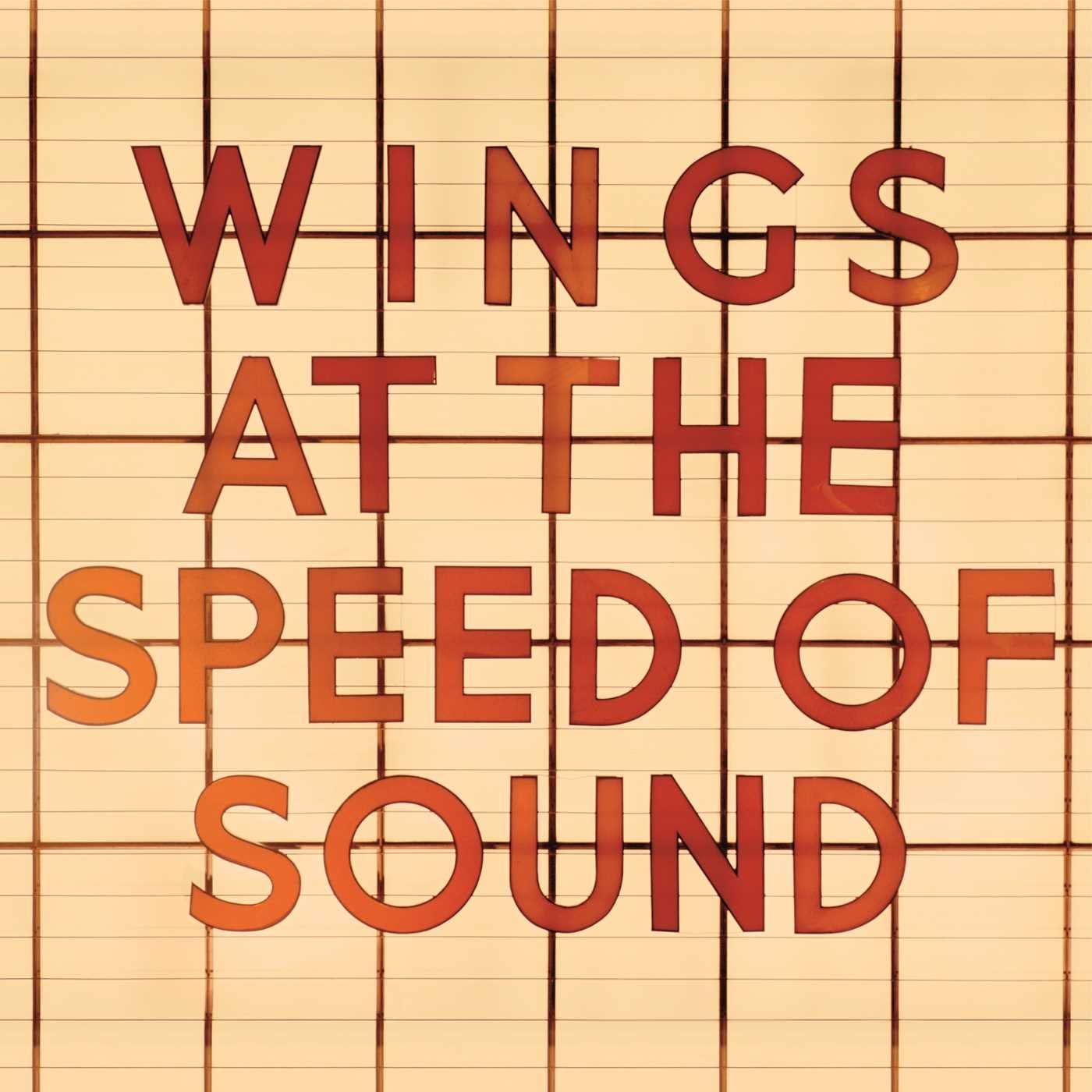
1. Wings at the Speed of Sound by Wings (1976)

Wings at the Speed of Sound

In The Lyrics, McCartney claims that “There were accusations in the mid-1970s – including one from John – that I was writing ‘silly love songs'”. Paul’s response? To double down and write more of them. ‘Silly Love Songs’ spent five weeks at number 1 in the Billboard Hot One Hundred in America and reached number 2 in the British pop charts. Who’s laughing now? With a bubbling, popping bassline that wanders delightfully all over the fretboard above a lilting string arrangement and punctuated by catchy-as-hell brass and wind section riffs, it’s an irresistibly infectious piece of 70s pop and one of the jewels in the crown of McCartney’s back catalogue.     

But Speed of Sound isn’t just silly love songs. ‘Beware My Love’, with its echoes of ‘Reach Out’ by The Four Tops is Motown seen through the prism of 70s hard rock (the alternative version with John Bonham of Led Zeppelin on drums that appears on the Archive Collection edition is worth tracking down). The pedaling bass and militaristic drum and wind arrangement on ‘Let ‘Em In’ sounds like little else in pop. The song’s message of inclusivity is more relevant now than ever.

McCartney’s attempt to accentuate Wings as a real group affair rather than just an ex-Beatle and his hired backing band works to great and diverse effect. Guitarist Denny Laine contributes two highlights – an affecting lead vocal on McCartney’s ethereal ‘The Note You Never Wrote’ and a soulful performance on his own top drawer composition ‘Time To Hide’ (that hints at ‘You Keep Me Hanging On’ in the verse), while Jimmy McCulloch’s Steely Dan-esque ‘Wino Junko’ features some excellent soloing. 

However, while I’m extremely reticent to indulge in anything that might appear to be Linda-bashing, the weakest track on the album by far is the under-baked, lightweight rock’n’roll of ‘Cook of the House’ which Linda sings and co-wrote with McCartney.  But it’s a minor irritation and doesn’t prevent this from being McCartney’s best record of the 70s. A joy from start to finish.  

Beatles Handbook rating: 5 Stars

Essential tracks
Silly Love Songs
Beware My Love 
Time To Hide
Let ‘Em In
San Ferry Anne 

Buy this album: Wings at the Speed of Sound by Wings

2. Band on the Run by Paul McCartney & Wings (1973)

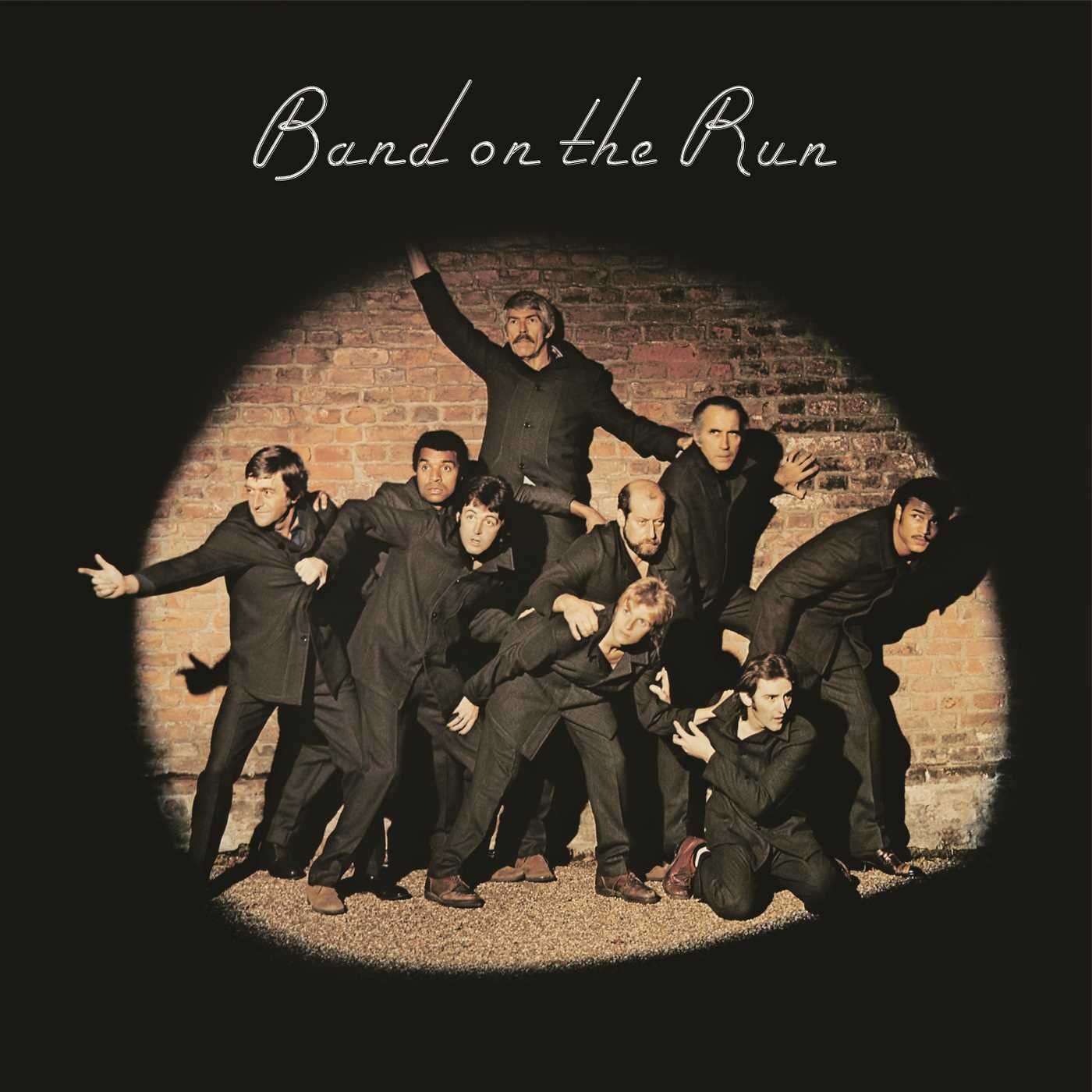
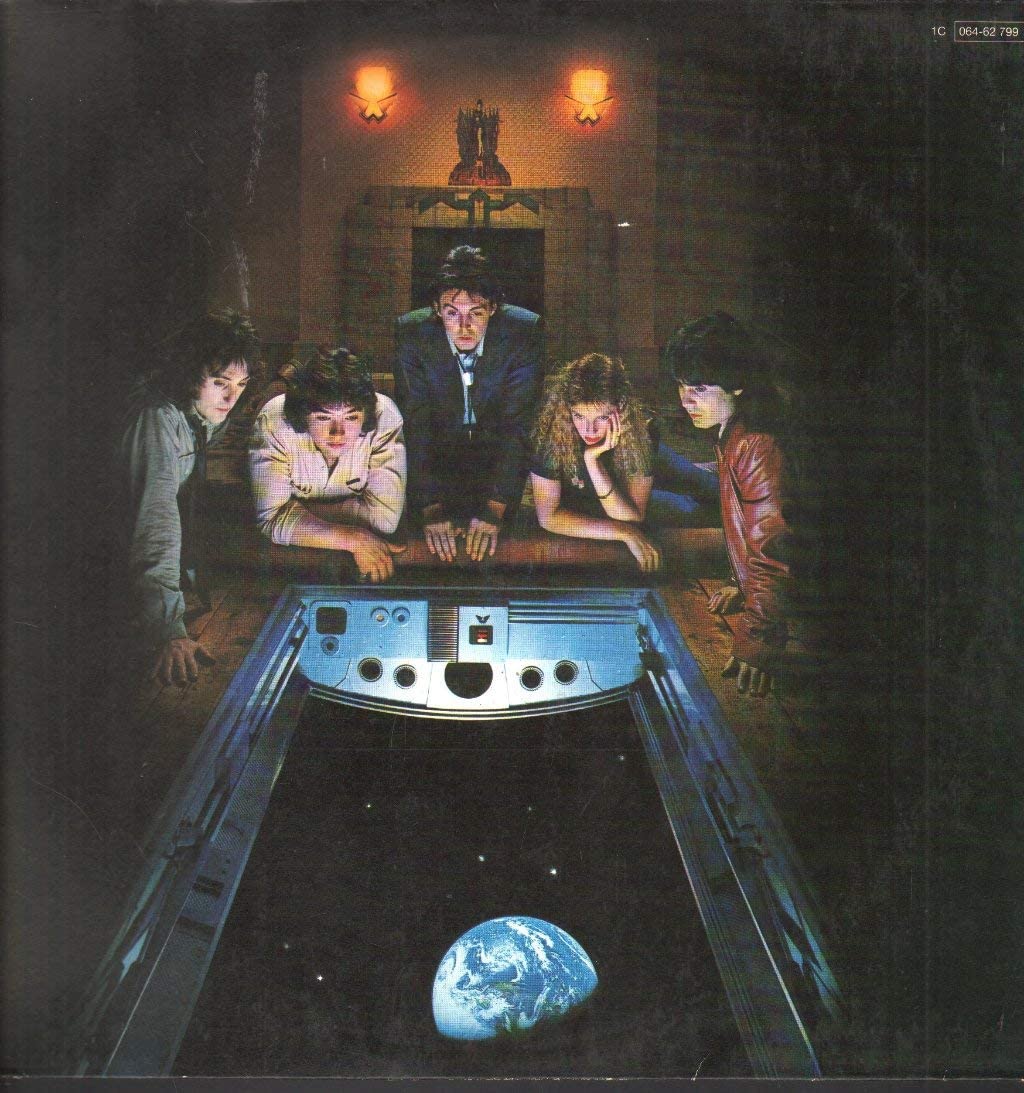
Band on the Run

One of McCartney’s best known records, Band on the Run is half a masterpiece. Side one (as it would have been on the original vinyl release) is solid gold, but the album seriously runs out of steam on side two. 

The title track, with it’s various musical sections threaded around a very loose lyrical narrative, has it’s antecedents in ‘A Day In The Life’, the suite of songs that closes Abbey Road and, as Paul Du Noyer points out in Conversations with McCartney, ‘Live and Let Die’ which McCartney wrote almost immediately before recording Band On The Run. The song had more than its fair share of  imitators, at least structurally, in tracks such as Queen’s ‘Bohemian Rhapsody’ or ‘I’m Mandy, Fly Me’ by 10cc, but none quite pull off the trick as well as ‘Band On The Run’.

From the meditative, melancholic opening with its lazily sliding guitar chords, wistful synth noodling and sweet vocal harmonies that’s ‘stuck inside these four walls’, to the broodingly angry distorted riffing of ‘if we ever get out of here’ that bursts into the euphoric acoustic strum that hopes ‘you’re having fun’, words and music are in perfect unison. In The Lyrics, McCartney explains that the theme of the song is freedom and that, “A lot of us at that time felt free from the strictures of civilisation. That’s one of the great things about rock and roll: it does allow you to break the rules.” McCartney evokes that renegade spirit perfectly in the line ‘we never will be found’, lending the band on the run a mythical other-worldly quality.  As an opener, it’s hard to beat. 

As for the following tracks, the words to ‘Jet’ remain delightfully opaque, even after reading McCartney’s ‘explanation’ in The Lyrics; the song is best enjoyed for what it is, a shouty old pop-rocker of the highest order. ‘Bluebird’ might be a slightly poor relation to ‘Blackbird’ but it still boasts a sublime melody that glides effortlessly over a blissful, relaxed bossa nova-like acoustic backing track. Although ‘Mrs. Vandebilt’ is a relatively minor McCartney work, it’s still packed with hooks and is a fine pop tune, and the repetitive, gritty Lennon-esque guitar figure on ‘Let Me Roll It’ slamming up against the bass and drum breakdown is a thrilling rock moment.  

Which brings us to side two. ‘Mamunia’ is a wafer thin slice of disposal pop with an irritatingly repetitive chorus; the word ‘ditty’ comes to mind, ‘No Words’ is like a pastiche of late period Beatles that could have been written by ELO or 10cc (i.e. beneath McCartney) and ‘Picasso’s Last Words’ is simply a dirge. Only the rousingly riff-tastic, piano-driven ‘Nineteen Hundred and Eighty Five’ saves the day and brings things to a satisfying conclusion. 

As with Let It Be, the circumstances surrounding the recording of Band On The Run go a long way to explaining why it’s such an uneven listen. Two band members abandoned ship on the eve of recording. The regrettable decision to record in Lagos was made where the studio turned out to be half built, there was a cholera outbreak and McCartney was mugged. That anything was recorded is something of a miracle, let alone an album that contains several classics. 

Beatles Handbook rating: 4 Stars

Essential tracks
Band on the Run 
Jet
Nineteen Hundred and Eighty Five  
Bluebird
Let Me Roll It

Buy this album: Band on the Run by Paul McCartney and Wings 

3. Red Rose Speedway by Paul McCartney and Wings (1973)
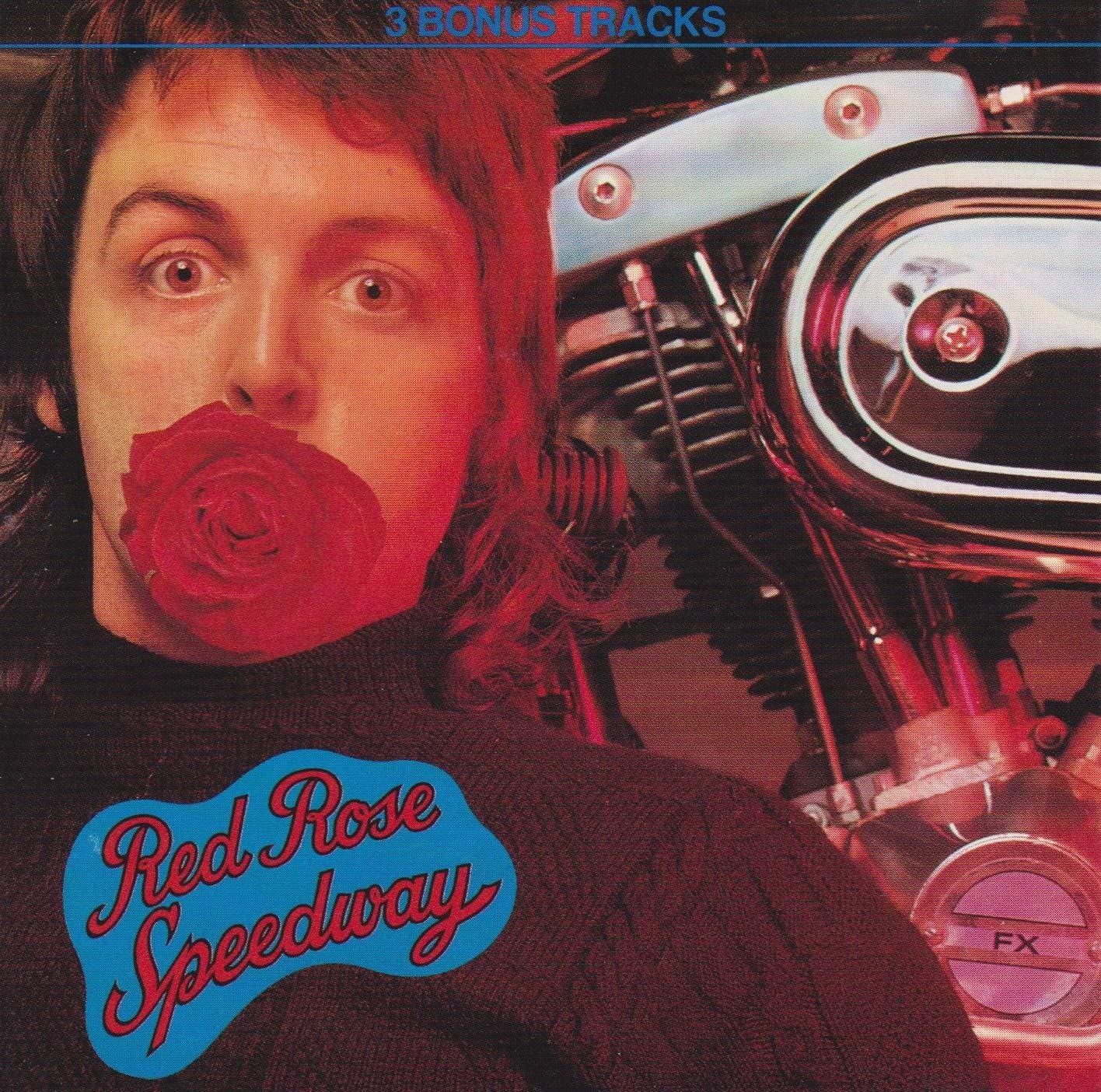
Red Rose Speedway

Red Rose Speedway is one of the most enjoyable albums in McCartney’s entire back catalogue, an opinion not many other people seem to share. Most damningly, producer Glynn Johns walked out on the recording sessions after four weeks, calling the music ‘shite’ and unimpressed by the band’s ‘lackadaisical’ approach, according to Man On The Run, Tom Doyle’s wonderful book on McCartney in the 70s.

Doyle also quotes Linda as describing it as ‘such a non-confident record’ and McCartney himself admitting ‘I don’t remember a lot about it actually. I think the fact that I don’t remember it too well bears that out’. Even Brian O’Conner of the Sodajerker song writing podcast, who chose the album for an episode of I am The Eggpod was equivocal about Speedway, calling it  ‘an overlooked entry in the Paul cannon…it’s by no means Paul’s finest work, far from it, but there’s just something about it that keeps bringing me back to it’.   

Du Noyer is more positive about the album in Conversations with McCartney, saying that the record marked ‘Paul’s commercial re-emergence’ following the ‘ramshackle’ Ram LP and ‘recovered some of the poise and consistency that was expected of Paul’. 

But I don’t care what anybody else says, Red Rose is a consistently great listen with no bad tracks. ‘My Love’ (I’m not sure anything more needs to be said about that guitar solo other than you ought to listen to it again right now) and the exquisite ‘Little Lamb Dragonfly’ aside, it may not reach the heights of the best tracks on Band on The Run, but from the insanely catchy rocker ‘Big Barn Bed’ to the closing medley of ‘Hold Me Tight/Lazy Dynamite/Hands of Love/Power Cut’ McCartney proves that he’s at his best when he stops messing about (see most of McCartney) and embraces his melodic gift. 

Given his unrivalled reputation and achievements, it’s tempting to judge all of McCartney’s output against the standard of ‘towering masterpiece of popular music’ and anything that falls below that as somehow being unworthy of anyone’s attention.  Red Rose is not a towering masterpiece, but it is bloody great way to spend 42 minutes of your life. Give it a go, you will not be disappointed. 

Beatles Handbook rating: 4 Stars

Essential tracks
My Love 
Big Barn Bed 
Little Lamb Dragonfly 
Single Pigeon
When The Night 
Loup 

Buy this album: Red Rose Speedway by Paul McCartney and Wings 

Red Rose Speedway is one of the most enjoyable albums in McCartney’s entire back catalogue, an opinion not many other people seem to share.

4. Ram by Paul McCartney and Linda McCartney (1971)
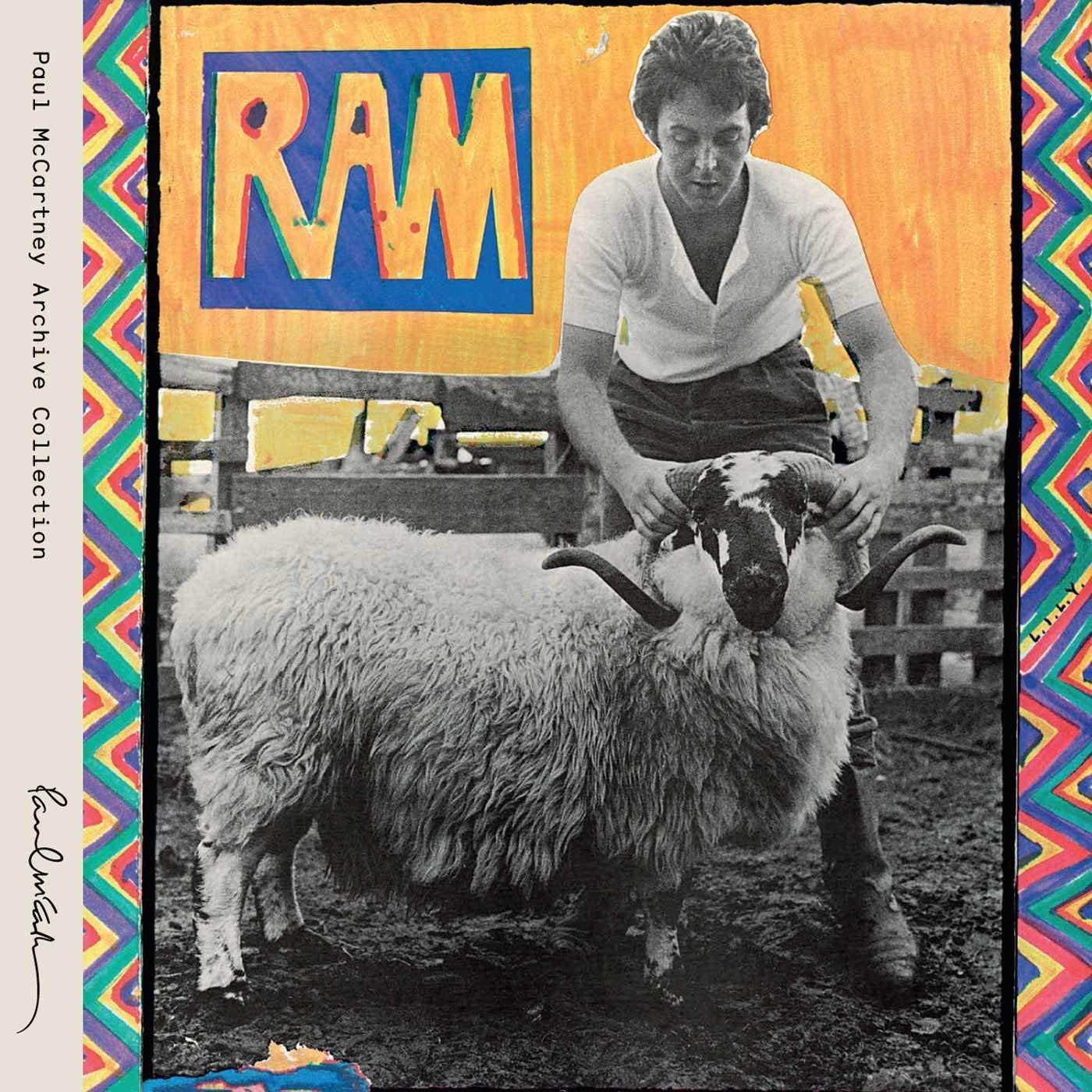
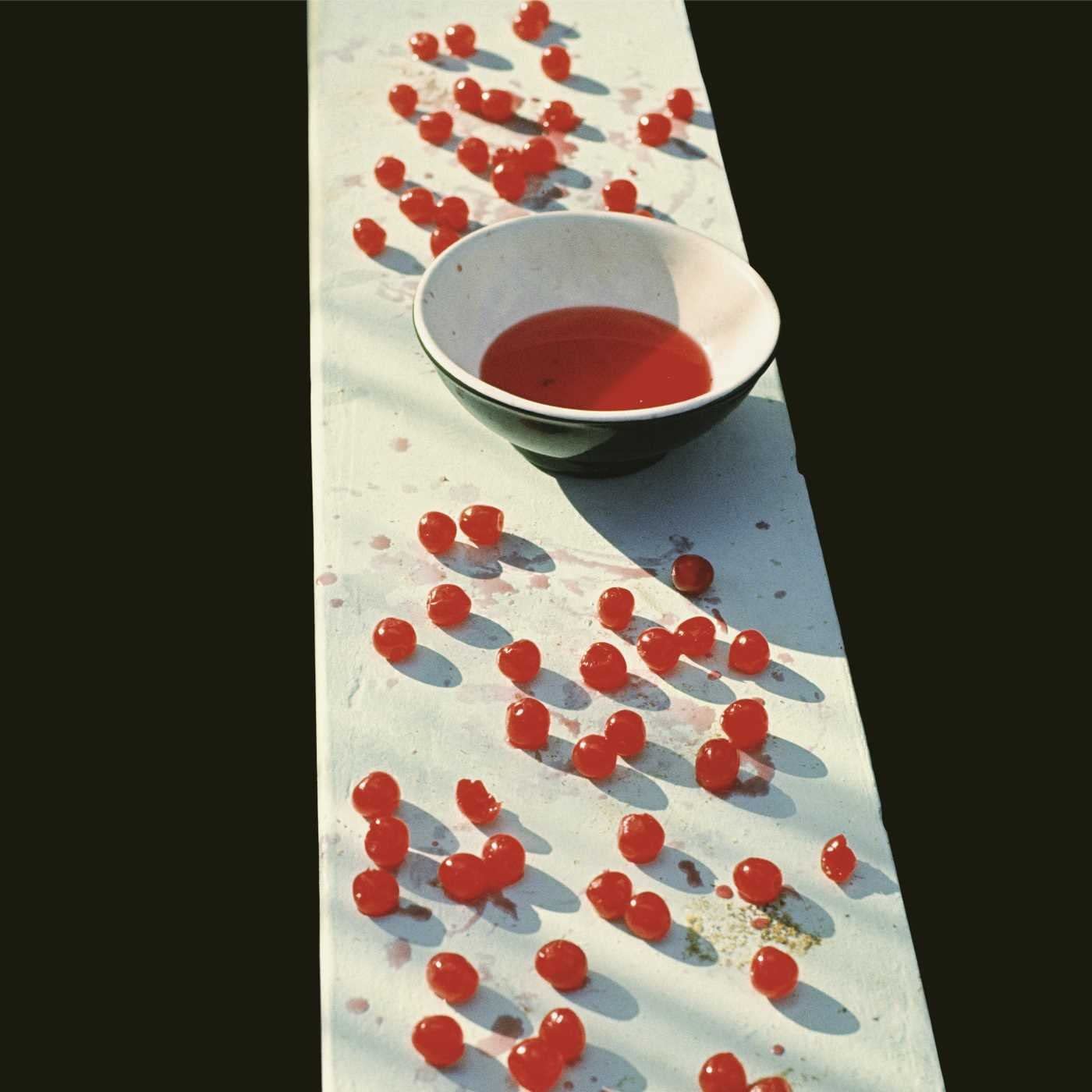
Ram by Paul McCartney

McCartney’s second post-Beatles albums suffers from both too many ideas and a paucity of them at the same time.  Overtly Beach Boys-influenced tracks such as ‘Dear Boy’ and ‘The Back Seat of My Car’ are packed with ‘baroque detail’ (Tom Doyle, Man on the Run) while tedious, chugging blues riffing sucks any interest from filler tracks like ‘3 Legs’, ‘Smile Away’ and ‘Eat At Home’. In between these two extremes, we find the six minute long, unnecessarily complex yet lumpen Hey Jude-alike ‘Long Haired Lady’ staggering on vainly in search of a melody that remains stubbornly furtive.  The John and Yoko diss track ‘Too Many People’ features some nice melodies and twangy guitar work, but a weak chorus and the endlessly noodling outro ultimately proves that negativity doesn’t best serve McCartney’s muse.  

But there are high points. ‘Ram On’ has a beguiling other-worldly feel, with a Beach Boy-ish melody soaring over a few simple strummed ukulele chords. In ‘Monkberry Moon Delight’, McCartney delivers surreal lyrics in an effectively scratchy, croaking growl over a mid-tempo stomping backing track with a great arrangement (including some nice BVs from Linda) that sustains interest over the five and half minute duration. ‘Heart of the Country”s laid back, bluesy feel, intimate relaxed vocal from Paul and memorable, hooky chorus make for an enjoyable listen. A minor transitional work; there was so much better to come. 

Beatles Handbook rating: 3 Stars

Essential tracks
Ram On
Monkberry Moon Delight
Uncle Albert/Admiral Halsey
Back Seat Of My Car 
Dear Boy
Heart of the Country 

Buy this album: Ram by Paul McCartney and Linda McCartney 

5. London Town by Wings (1978)

London Town by Wings

A disparate collection of tunes that pinballs from catchy pop (‘With a Little Luck’, ‘Cafe On The Left Bank’) to funk and soul (the instrumental ‘Cuff Link’ and album standout ‘Girlfriend’) to touching ballad (‘I’m Carrying’) to folky strum (the Steeleye Span-ish ‘Children Children’, the forgettable ‘Famous Groupies’ and the memorable ‘Deliver Your Children’) to Beatle-like bluesy trudge (‘I’ve Had Enough’).

If that wasn’t enough, McCartney throws in an Elvis impersonation on the hard rocking ‘Name and Address’ and a helping of faux fiddle-di-de on ‘Morse Moose And The Grey Goose’. As the follow up to Speed of Sound, it’s a let down for sure but there are some exquisite songs including the beguiling title track and slow burning ‘Don’t Let It Bring You Down’ (I do love a McCartney/Laine co-write) that make it worth persevering with.  Few would want to listen to the entire overlong, meandering mélange too many times, but there’s plenty to enjoy and admire here once you’ve picked your way through the clutter.   

Beatles Handbook rating: 3 Stars 

Essential tracks
With a Little Luck
Don’t Let It Bring You Down
Girlfriend
London Town 
Cafe on the Left Bank 
Deliver Your Children
I’m Carrying 
Backwards Traveller 

Buy this album: London Town by Wings 

6. Wild Life by Wings (1971)

Wild Life by Wings

The fact that there are two people named Denny playing on Wild Life (guitarist Laine and drummer Seiwell) might be the most interesting thing about this album. As Paul, Linda and their then new found mates bugger around for a good half of the 38 minute running time, I find my mind wandering. “Surely one was called Danny? I mean, it’s like Madonna making a record with someone else called Madonna. Or there being two Derrens, or Davinas. Did McCartney originally hire Denny Laine because his name sounds a bit like Penny Lane? Were the Dennys  referred to only by their surnames to avoid confusion in the studio, or did they have numbers, like Thing One and Thing Two? Two Dennys, what are the odds…”. 

When I can focus on the music as it drifts by, other questions occur to me such as ‘The title track, ‘Some People Never Know’ and ‘Dear Friend’ are all wonderful. Why didn’t McCartney just try harder?” and, “Hadn’t McCartney ever heard of EPs”.  That is perhaps a little unfair, as the four songs on what would have been side two of the original release hang together well and display many of McCartney’s best attributes as a songwriter. But it’s an uneven listen overall with McCartney still finding his feet in a post-Beatles world. 

Beatles Handbook rating: 3 Stars 

Essential tracks
Wild Life 
Some People Never Know
Dear Friend 

Buy this album: Wild Life by Wings 

7. Venus and Mars by Wings (1975)
Venus and Mars by Wings

And it all starts so well. ‘Venus and Mars’ is one of those snaking ear-worm melodies that McCartney seems to be able to pull out of thin air. The chiming guitar chords and harmonising bass notes seem to be taking the music to somewhere unexpected. But suddenly we’re into ‘Rock Show’ and everything turns bog standard vanilla with McCartney wailing about ‘rock’n’roll at the Hollywood Bowl’ like he’s completely run out of ideas for lyrics. It’s just horrible. 

Although there’s far too much turgid 70s rock on the record, it’s far from all bad. There’s the haunting ‘Love in Song’, beautiful ‘Treat Her Gently’ and of course ‘Listen To What The Man Said’, a highlight of McCartney’s work in the 70s and one that foreshadows the treasures in store on Speed Of Sound.    

Beatles Handbook rating: 3 Stars

Essential tracks
Treat Her Gently – Lonely Old People
Listen To What The Man Said 
Love In Song 

Buy this album:  Venus And Mars by Wings 

8. McCartney by Paul McCartney (1970)
McCartney by Paul McCartney

It’s worth noting the historical context in which this album was made before you read the damning verdict that follows.  McCartney’s first solo album was recorded while he was still officially a Beatle and during the band’s messy break up. It says something profound about McCartney’s unrelenting drive as a creative force (and his ambition) that he would seek to begin to establish his musical identity as a solo artist even as his role as band member/leader was being painfully taken from him.

McCartney unquestionably documents an important moment in popular musical history. But it also documents Paul dicking about by himself for the majority of the running time, making it an extremely unrewarding listen. But among all the under-developed, under-produced inconsequential whimsy, McCartney manages to pull out three stunners just to remind the world of his genius.

Although ‘Every Night’ would have benefitted from a more detailed arrangement, it is a beautifully constructed, hook laden ballad where a pensive melancholic verse  resolves effortlessly into a joyful, celebratory chorus. It wouldn’t be out of place on a late period Beatles album. It’s not surprising that it’s been covered many times, including a striking version by Richie Havens.  ‘Junk’ is a gorgeously simple acoustic ballad with a floating wistful melody and a lyric about consumerism that feels very contemporary.  But the true stand out is ‘Maybe I’m Amazed’ – the instantly recognisable piano riff, bluesy impassioned vocal, carefully constructed guitar solos and the remarkable lyric, a love song about ‘fear and loneliness’ as McCartney explains in The Lyrics

Despite the presence of these three classics, McCartney remains an album for completists only. 

Beatles Handbook rating: 2 Stars

Essential tracks
Maybe I’m Amazed
Every Night
Junk

Buy this album: McCartney by Paul McCartney

9. Back to the Egg by Wings (1979)

Back to the Egg by Wings

An album not worthy of your time.  The sophisticated blue-eyed soul of the Michael McDonald influenced ‘Arrow Through Me’ is a great track and ‘So Glad To See You Here’ provides Eagles of Death Metal with a template for an entire career  (the similarity to that band’s particular brand of perky, bouncing 12 bar riffing is really quite spooky) but there really is not much else to appeal in another motley selection of uninspired second and third rate compositions.

McCartney sounds uncomfortable in his own skin, trying on a variety of musical disguises, from the Bowie-ish ‘To You’ to the punky ‘Spin On It’, none of which really suit him.  Yes, he can pull off a jazzy 20s style ballad with ‘Baby’s Request’, complete with some lovely vocal harmonies, but the question is why bother? It’s a b-side at best and adds one more unnecessary ingredient to an already muddy musical stew. 

Beatles Handbook rating: 2 Stars 

Essential tracks
Arrow Through Me 
So Glad To See You Here 
Getting Closer

Buy this album: Back To The Eggs by Wings 

The Beatles Albums Ranked

1 Revolver

Revolver

Most songwriters would give their right arm for just one of the melodies, riffs or chord sequences on Revolver. The playing is terrific too. From the looping bass, taut guitar stabs and crisp drumming of the opening ‘Taxman’, to the hallucinatory ‘Tomorrow Never Knows’ with that legendary, defining Ringo drum pattern, The Beatles sound like the tightest band on the planet.  And they don’t just hit the back of the net with rock, pop and psychedelia; whatever they turn their hand to on the album is pure gold, from the heart-breaking pathos of ‘Eleanor Rigby’ with its haunting double string quartet arrangement, to the achingly tender ‘Here, There and Everywhere’, arguably McCartney’s most beautiful love song. With every track a banger (and no, I’m not excluding ‘Yellow Submarine’ which has the hookiest chorus ever written), it’s unquestionably the highpoint of The Beatles recording career. An awe-inspiring achievement, especially when you consider it was released only eight months after Rubber Soul and that many of the tracks wouldn’t even make a top 20 of The Beatles best known songs.

Beatles Handbook rating: 5 Stars

Essential tracks
Eleanor Rigby
Here, There and Everywhere
And Your Bird Can Sing
Got To Get You Into My Life
Tomorrow Never Knows

Buy this album: Revolver

2 Help!

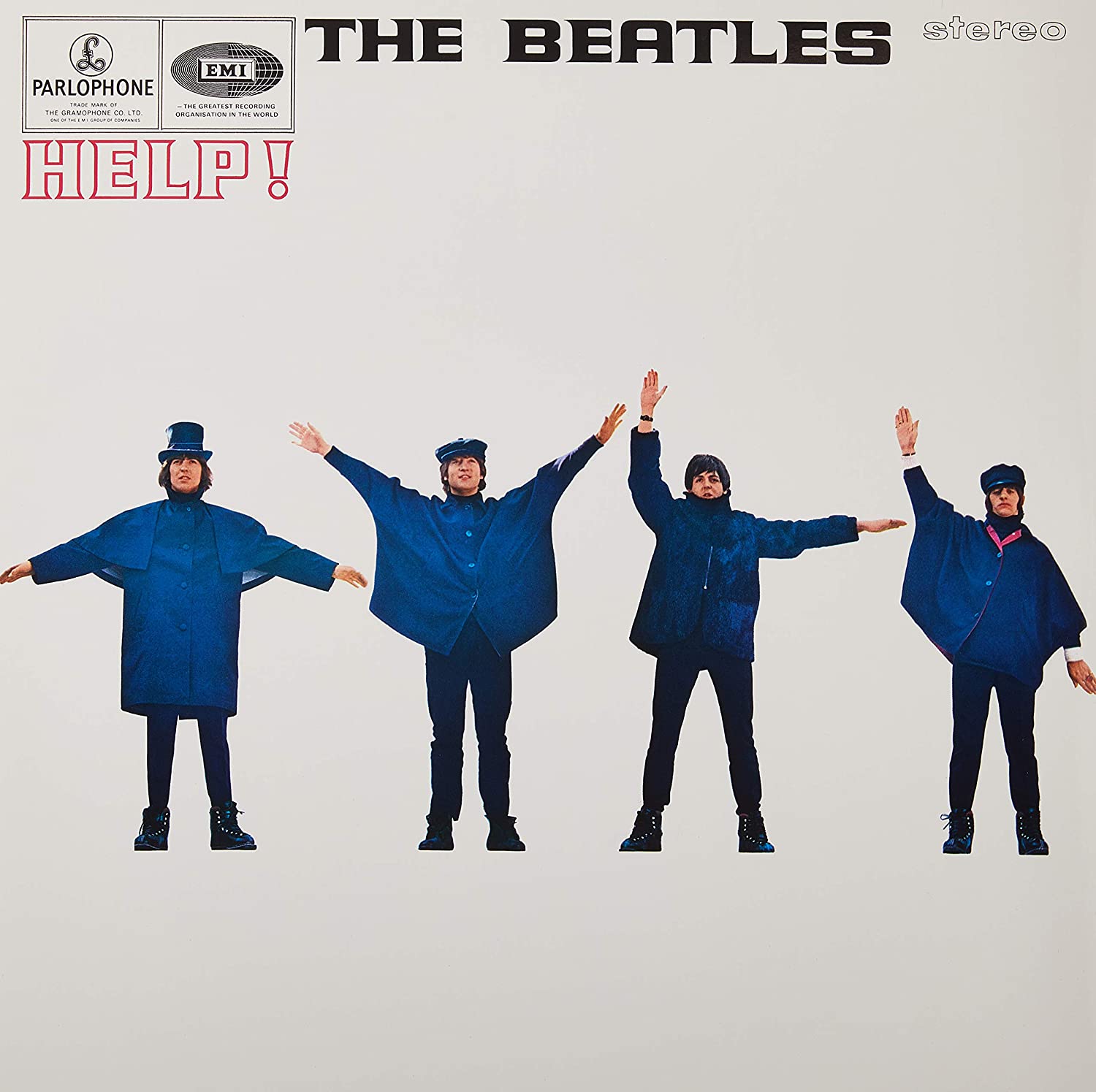
Help

For any other band, Help! would be a greatest hits album. But because this is The Beatles, it’s just another shift in the mop tops’ factory of greatness. With what must be the most impactful beginning of any pop album, ‘Help!’ makes for a direct, startling opening statement, vulnerable and yet uplifting as though by simply making the request, Lennon has made himself feel better. With only one track tipping the three minute mark (Ticket To Ride at a hardly epic 3m9s), the band rattle though 14 perfect slices of guitar pop.  Every track is a cracker, including the Ringo-sung ‘Act Naturally’.  As astonishingly excellent as the film it soundtracks is appallingly bad. 

Beatles Handbook rating: 5 Stars

Essential tracks
Help!
The Night Before
You’ve Got to Hide Your Love Away
You’re Going to Lose That Girl
Ticket To Ride

Buy this album: Help!

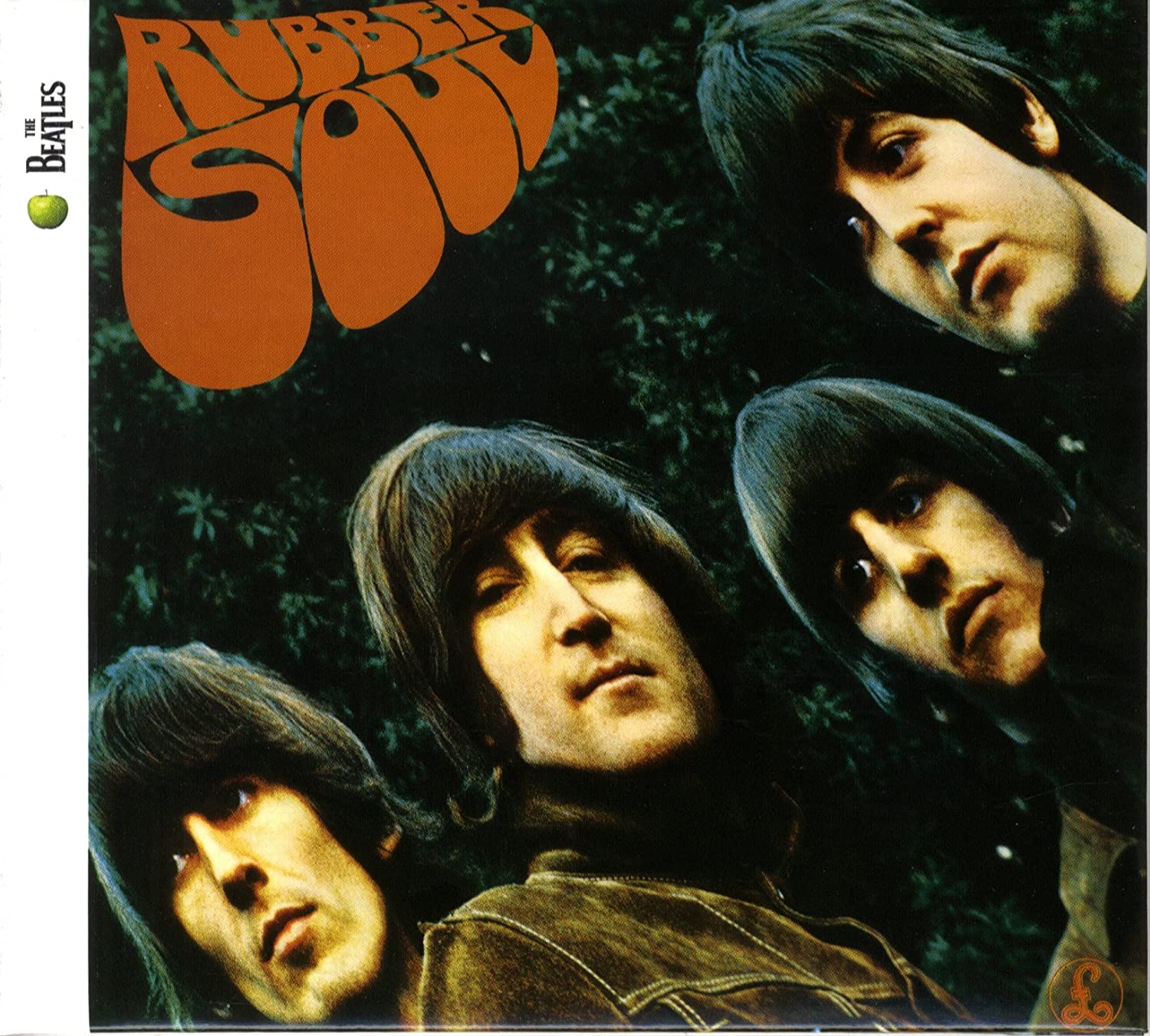
3 Rubber Soul

Rubber Soul
It’s amazing what you can do with some tight guitar riffs, even tighter vocal harmonies, passing piano chords and a killer hook line. ‘Beep, beep, beep, yeah’ indeed. It’s incredible to think that, a little more than two years earlier, the same four lads were banging, thrashing and crooning their way through a disparate rag bag of rudimentary rockers and schmaltzy ballads. And ‘Drive My Car’ is just one of any number of sophisticated, mature, memorable and melodic songs on what isn’t even their best album. It may be a music mag all-time-best-list staple but it can’t quite keep pace in terms of quality with Help!  or Revolver, but make no mistake, this is a band close to the very height of their powers sounding both assured, thrilling and moving by turns.

Beatles Handbook rating: 4 Stars

Essential tracks
Drive My Car
Norwegian Wood
Nowhere Man
The Word
Girl
I’m Looking Through You
In My Life

Buy this album: Rubber Soul

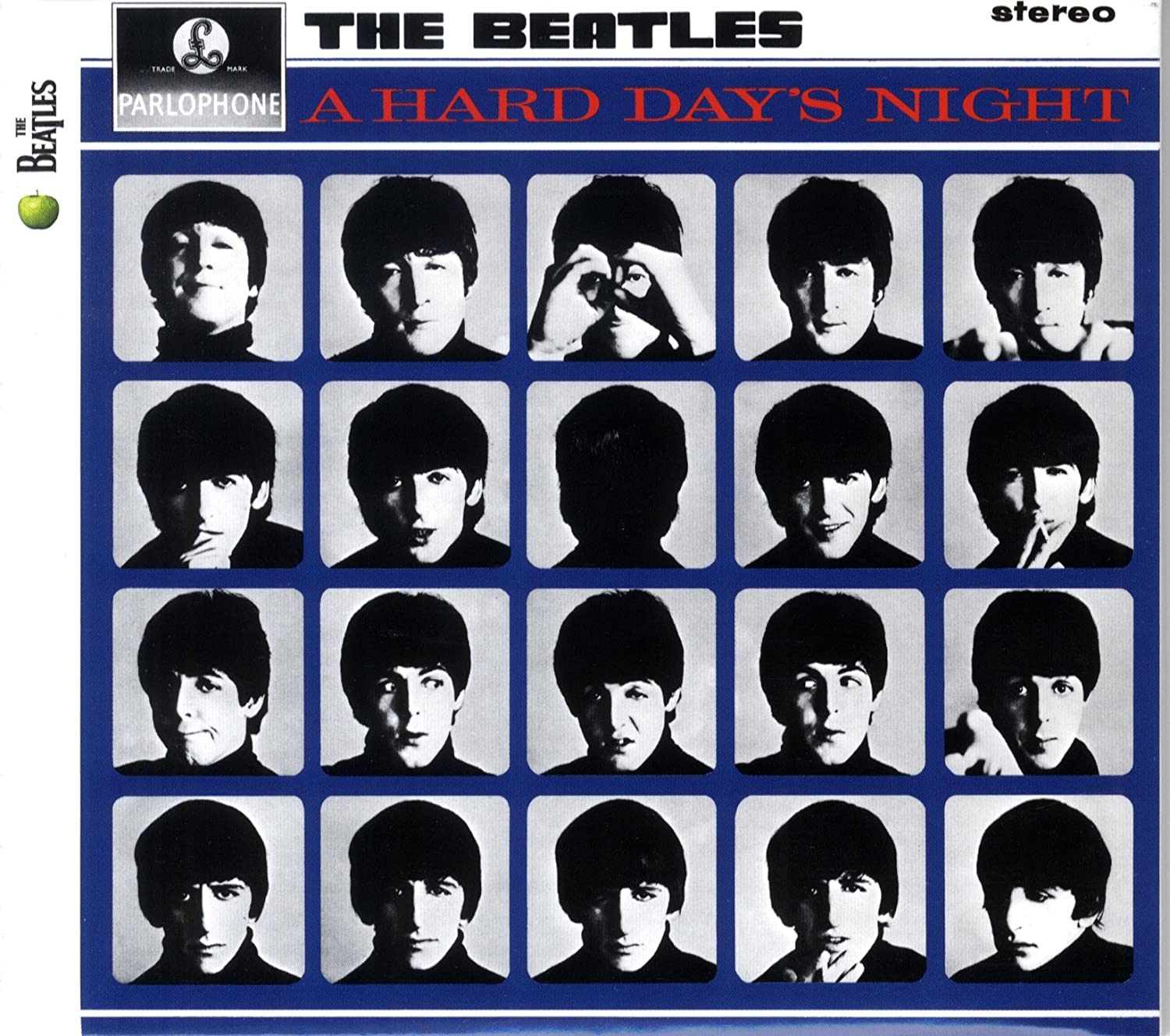
4 A Hard Day’s Night

Hard Days Night
As Luke Haines recently noted in his column in Record Collector, “the opening chord of ‘A Hard Day’s Night’… singlehandedly seemed to usher in a new era”.  It certainly ushered in a new era for the mop tops themselves with what might be considered by contemporary listeners as their first ‘proper’ album. Most of the Hamburg hard edges have been sanded off and chugging rock’n’roll for the most part replaced by sophisticated song writing with ace melodies and harmonies. Lennon dominates, taking lead vocals on nine out of the thirteen tracks and, according to beatlesarchive.net, writing ten, but McCartney still manages to make a big impression with his three contributions; the hauntingly beautiful ‘And I Love Her’ (the signature opening guitar motive courtesy of Harrison),  the instantly catchy ‘Things We Said Today’ and of course the timeless classic ‘Can’t Buy Me Love’.  Harrison is given ‘I’m Happy Just To Dance With You’ to sing, one of the weaker numbers that wouldn’t have been out of place on Please Please Me or With The Beatles but it’s still a pleasant enough sub-two minute listen. A great album that soundtracks the band’s finest moment on film.

Beatles Handbook rating: 4 Stars

Essential tracks

A Hard Day’s Night
I should Have Known Better
If I Fell
And I Love Her
Can’t Buy Me Love
Things We Said Today
I’ll Be Back

Buy this album:  Hard Day’s Night 

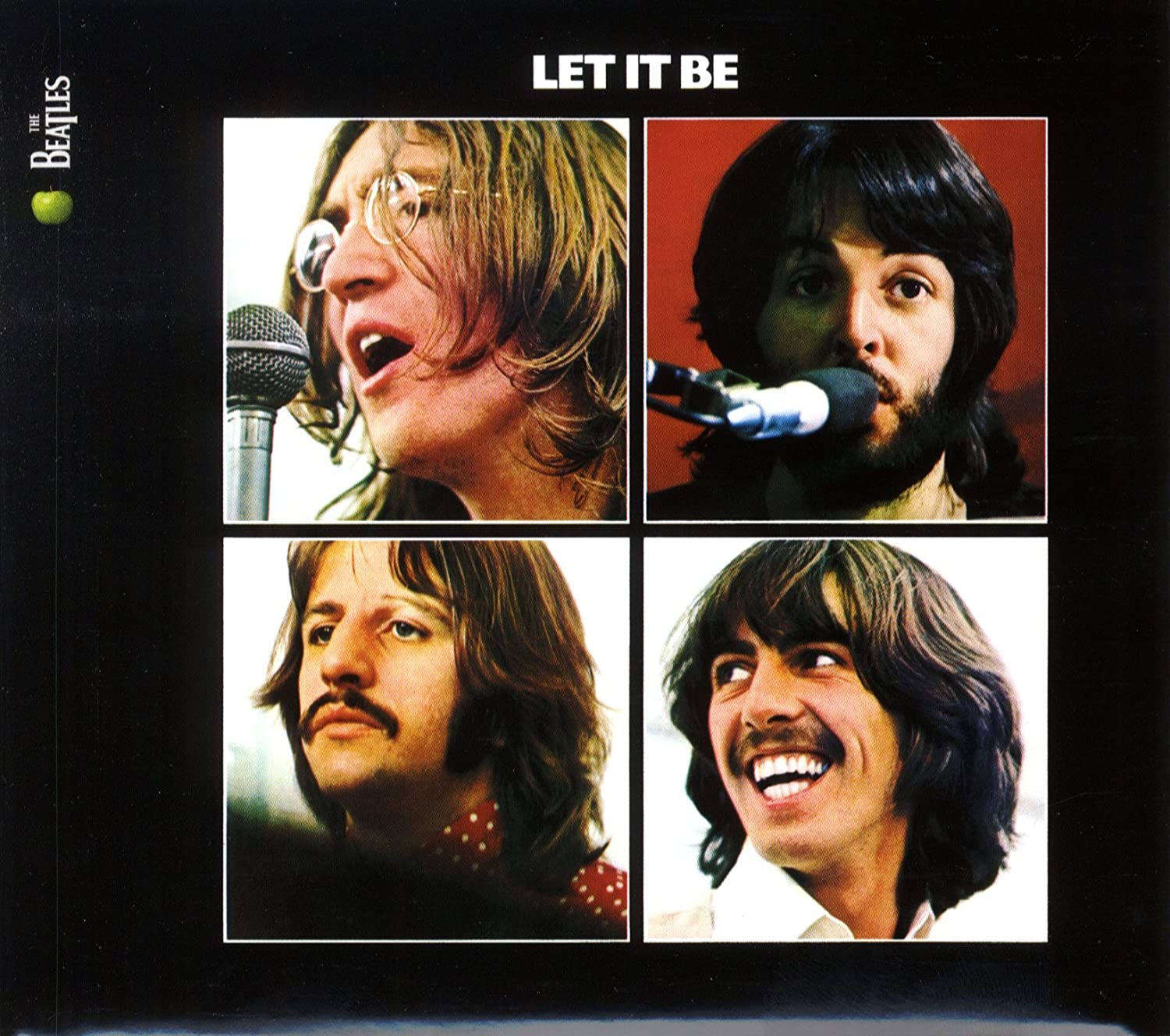
5 Let It Be

Let It Be

An album that includes songs of the quality of ‘Across The Universe’, ‘Let It Be’, ‘The Long and Winding Road’ and ‘Get Back’ should rate five stars, but it’s actually somewhat of a disappointment.  The inclusion of two sub-one minute tracks (‘Dig It’ and ‘Maggie Mae’), a piece of Lennon juvenilia in the form of ‘One After 909’, and Harrison’s lightweight ‘For You Blue’ gives Let It Be an uneven quality. That’s exacerbated but the inclusion of second division songs (at least in the context of The Beatles catalogue) ‘Dig a Pony’ and ‘I’ve Got a Feeling’, but it’s hardly surprising once you’ve seen the film Get Back and understand the chaotic nature of the rehearsal and recording sessions for the album. McCartney’s touching and wistful ‘Two of Us’ and Harrison’s waltzing ‘I Me Mine’ are the album’s two relatively hidden gems.    

Beatles Handbook rating: 3 stars

Essential tracks
Two of Us
Across The Universe
I Me Mine
Let It Be
The Long and Winding Road
Get Back

Buy this album: Let It Be

6 The Beatles (White Album)

The Beatles White Album
Where to start with The Beatles by The Beatles? An album that sounds like an extended re-issue of itself with bonus tracks that should never have seen the light of day (WTAF is Wild Honey Pie?). Starting at the beginning is actually a very good idea as you get to hear ace rocker ‘Back In The U.S.S.R’., the dreamy psychedelia of ‘Dear Prudence’ and the archly self-referential ‘Glass Onion’. Then the problems start. Oh bloody hell, it’s ‘Ob-La-Di, Ob-La-Da’, McCartney at his absolute worst, culturally appropriating a story that’s not his to tell over a weird and horrible umpah-meets-cod-reggae backing track. Jesus wept. At least the aforementioned ‘Wild Honey Pie’, the next track up, with its faux avant garde stylings has the decency to last a merciful 53 seconds.

I’m not going parse all 30 tracks of this sprawling mess, but suffice to say that to get to every magnificent song such as Harrison’s ‘While My Guitar Gently Weeps’, Lennon’s ‘Julia’  or McCartney’s ‘Blackbird’ you have to wade through dreck like ‘The Continuing Story of Bungalow Bill’ or the more than eight unlistenable minutes of ‘Revolution 9’ (if anyone tries to tell you that, actually, that’s their favourite Beatles song, run). It is however almost worth the slog to end up at one of the loveliest songs the band ever recorded, ‘Good Night’, affectingly sung by Ringo.

Beatles Handbook rating: 3 stars 

Essential tracks
Back In The USSR
Dear Prudence
While My Guitar Gently Weeps
Happiness Is A Warm Gun
Martha My Dear
Helter Skelter
Julia
Mother Nature’s Son
Everybody’s Got Something to Hide
Revolution 1
Cry Baby Cry
Good Night

Buy this album: The Beatles

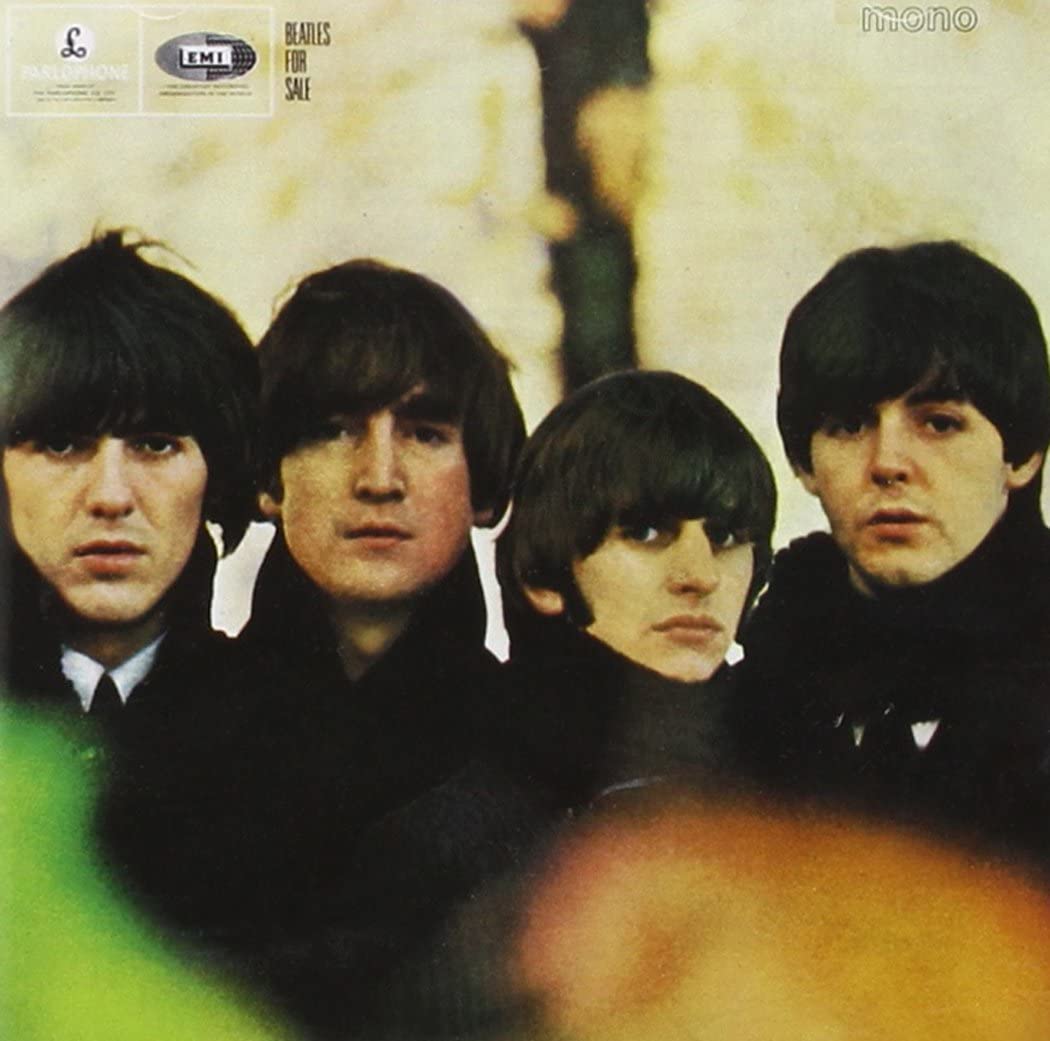
7 Beatles For Sale

Beatles For Sale
Sorry, I’m not buying. Compared to the giant leap forward that was A Hard Day’s Night, Beatles For Sale is a big step back. But let’s be fair; it was released just 21 weeks after Hard Day and was the fabs fourth album in two years. No wonder they resorted to padding out the 33 minute running time with no less than six cover versions. We are sadly back in Hamburg it seems, but at least Chuck Berry’s ‘Rock’n’Roll’ and Leiber/Stoller/Penniman’s ‘Kansas City’ sound convincingly raucous. The less said about Ringo’s rather painful stab at Carl Perkins’ ‘Honey Don’t’ the better.  Of the originals, ‘Eight Days a Week’ is the obvious stand out but the nakedly vulnerable, confessional lyrics of ‘I’m A Loser’ are striking, ‘Every Little Thing’ is a beautifully constructed pop song full of hooks, and Harrison’s twelve string riff gives ‘What You’re Doing’ a distinctive sound that would be much copied by the likes of The Byrds.

Beatles Handbook rating: 3 stars

Essential tracks
No Reply
I’m A Loser
I’ll Follow The Sun
Eight Days a Week
Every Little Thing
What You’re Doing

Buy this album: Beatles for Sale


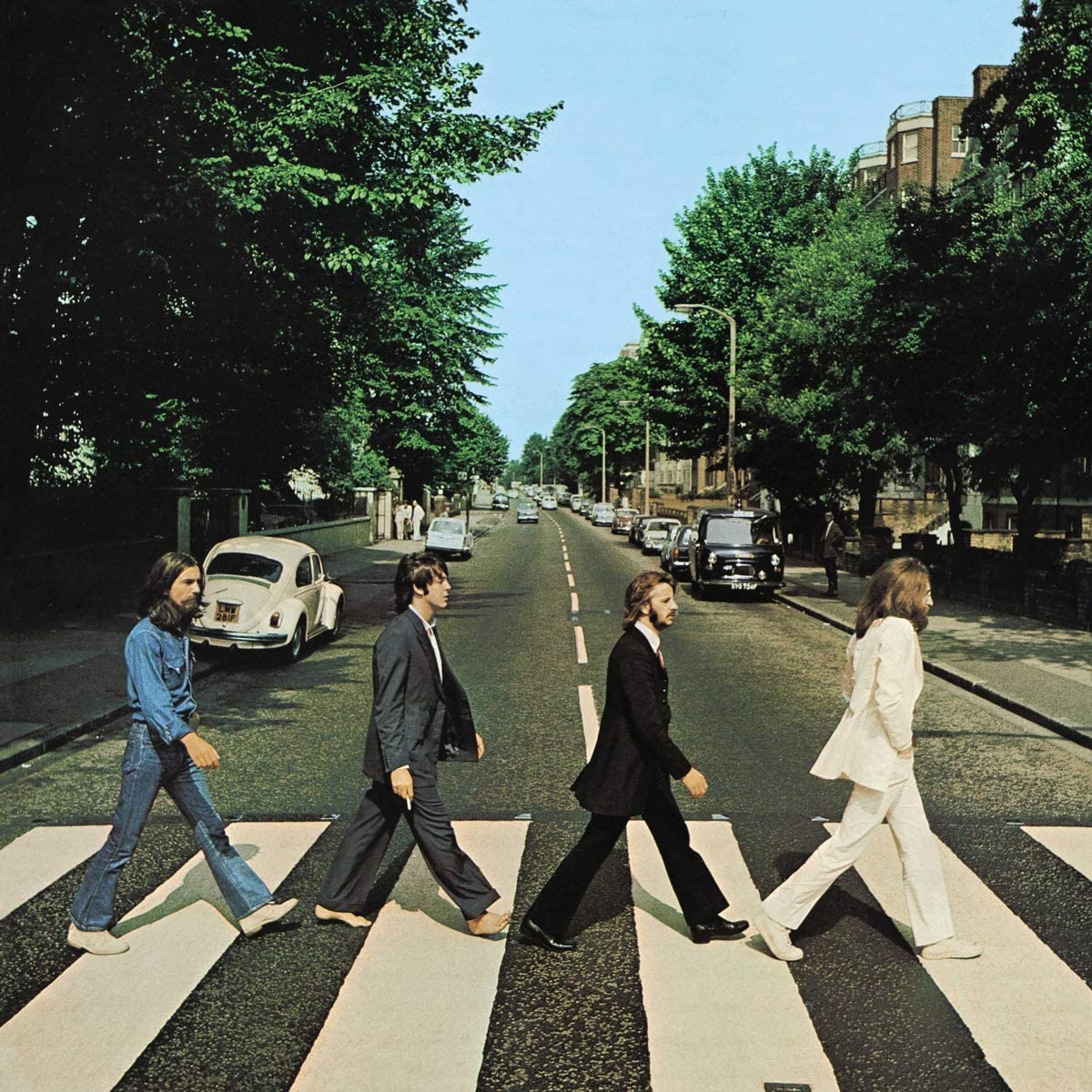
8 Abbey Road

Abbey Road

The band’s final recordings (although penultimate release; Let It Be appeared eight months later) are sadly a rather scrappy affair. Harrison comes out on top with two stone cold, all time classics in ‘Something’ and ‘Here Comes The Sun’, not only the best songs on the album, but among the best he ever wrote and among the best of the entire Beatles catalogue. Lennon’s strident ‘Come Together’ makes an ear-grabbingly effective opener, especially with Ringo’s rolling drum pattern, one of the most famous in pop history. 

Beyond that, things get rather messy. Apart from inventing three chord punk nearly a decade before the Sex Pistols with ‘Polythene Pam’, there is McCartney’s music hall fetish in the form of ‘Maxwell’s Silver Hammer’, the white man’s doo-wop of ‘Oh! Darling’ and whatever the hell ‘Octopus’s Garden’ is meant to be to contend with. Not to mention a patience-testing 7 minutes 47 seconds of ‘I Want You (She’s So Heavy)’, although the extended instrumental outro is pretty mesmerising. 

There are some stunning moments scattered around, ‘Sun King’ is a rather lovely thing, reminiscent of Fleetwood Mac’s ‘Albatross’, and there are some great melodies on ‘You Never Give Me Your Money’ and ‘Golden Slumbers’, but ultimately the album fails to cohere in the same way as Revolver or Help!.

Beatles Handbook rating: 3 Stars

Essential tracks
Something
Here Comes The Sun
Sun King 
You Never Give Me Your Money
Golden Slumbers

Buy this album: Abbey Road

9 Magical Mystery Tour

Magical Mystery Tour
Not a full studio album as such but a compilation of a double ep soundtrack to a made-for-TV film plus some singles. It might be a bit of a mess thematically (as is the film itself, and that’s putting it mildly) but that’s hardly a rare trait in the Beatles album canon and it does contain some of The Beatles best-known songs.  The original British ep release not only included the rousing title track (a far better signature tune for a concept than St. Pepper’s) but ‘The Fool On The Hill’ one of McCartney’s greatest and most unusual compositions, ‘I Am The Walrus’, Lennon’s most successful stab at musical and lyrical surrealism, and Harrison’s remarkable, woozy and weird ‘Blue Jay Way’ (is there anything in pop or rock that sounds quite like it?).

The collection of non-album A and B sides that make up the rest of the album is almost ridiculous in terms of its quality. ‘Hello, Goodbye’, ‘Strawberry Fields Forever’, ‘Penny Lane’ and ‘All You Need Is Love’ are of course among the cream of the Beatles crop; even ‘Baby, You’re A Rich Man’, the B-side of ‘All You Need Is Love’ is a cracker.

Because it’s status as an album is questionable and having all those non-album singles on it is sort of ‘cheating’ in the context of the band’s other releases which lack that advantage, it appears lower down on this list than it might do.  A great listen, especially for those whose favourite Beatles album would be ‘The Best of The Beatles’.

Beatles Handbook rating: 4 stars

Essential tracks
The Fool On The Hill
I Am The Walrus
Blue Jay Way
Hello, Goodbye
Strawberry Fields Forever
Penny Lane
All You Need Is Love

Buy this album: Magical Mystery Tour 

10 Sgt. Pepper’s Lonely Hearts Club Band

Sgt Peppers Lonely Hearts Club Band
The first Beatles album I bought as a kid, aged 11. I never really liked it and now, more than four decades years later, I still don’t. It sounds to me like a band losing their way; the Sgt Pepper’s conceit merely a way of bringing some sort of cohesion to a very disparate group of songs written by musicians with one eye on the exit door.  You can either view the juxtaposition of ‘Within You Without You’ and ‘When I’m Sixty Four’ as audacious and daring or simply desperate. ‘Lucy In The Sky’ has aged badly into try-hard psychedelia; ‘Fixing a Hole’ is uninspired, lumbering and mundane, ‘She’s Leaving Home’ is a re-tread of the vastly superior ‘Eleanor Rigby’ and ‘Being For The Benefit of Mr. Kite!’ is much less clever and much less listenable than Lennon probably thought it was.  ‘A Day In Life”s haunting refrain is swamped by over production and the unwelcome intrusion of McCartney’s ‘middle eight’. It’s a striking, innovative piece but I’m not sure I’d ever want to listen to it for fun. It’s another album that would make a great EP with ‘With A Little Help From My Friends’ and Ringo’s touchingly performed vocal providing the lead track.

Beatles Handbook rating: 3 stars 

Essential tracks
With A Little Help From My Friends
Getting Better
Lovely Rita
Good Morning Good Morning

Buy this album: Sgt. Pepper’s Lonely Hearts Club Band


11 Yellow Submarine

Yellow Submarine

A curio in The Beatles album canon. The soundtrack to the animated film contains only four previously unreleased songs, the rest of the running time made up from the title track, which previously appeared on Revolver,  ‘All You Need Is Love’ which was a single and also collected on Magical Mystery Tour, and George Martin’s instrumental orchestral music for the film, none of which will be troubling us here. Unusually, Harrison gets two out of the four new cuts and both are very decent examples of late period Beatles. The inventive and unusual ‘Only A Northern Song’ is built around a loping bassline and random-sounding soundscape of squawling trumpets and backwards tape loops that is much easier on the ear than that description might sound. ‘It’s All Too Much’ is a medium paced stomper with a droning organ riff and busy percussion track supporting a lilting verse melody and catchy chorus hook that all adds up to a distinctive and enjoyable addition to the bands catalogue. ‘Hey Bulldog’s driving piano riff underpins a snarling, menacing Lennon vocal to great effect, but McCartney’s throwaway knees up ‘All Together Now’ irritates rather than amuses. One for Beatles collectors rather than the general listener.

Beatles Handbook rating
3 Stars

Essential tracks
Northern Song
Hey Bulldog
It’s All Too Much

Buy this album: Yellow Submarine

12 Please Please Me

Please Please Me

Released shortly after their return from their extended show band stint in Hamburg, Please Please Me sounds like a historical recording from an ancient civilisation. That the album sounds underwhelming now should come as no surprise; after all, The Beatles had been so busy performing for eight hours a day that they hadn’t quite got around to creating modern pop music.
 
Instead, we get a rather underpowered impersonation of The Beatles’ rock’n’roll heroes (‘I Saw Her Standing There’ sounds pretty energetic until you play ‘Good Golly Miss Molly’ immediately after and Little Richard really blows your hair back) along with some pretty schlocky and sappy love songs.  The title track hints at the greatness to come, as does Lennon’s  plaintive harmonica refrain on ‘There’s A Place’ and the song’s touchingly introspective lyrics. Ringo’s forceful, driving vocal on ‘Boys’ is another highlight.
 
For those that lived through the era, it’s no doubt an essential album and that has to be respected, but if you missed out on those heady days this is a record you can probably live without.


Beatles Handbook rating
2  Stars

Essential tracks
Please Please Me
Do You Want To Know A Secret
Baby It’s You
Boys
There’s A Place

Buy this album: Please Please Me


13 With The Beatles

With The Beatles
Released eight months after Please Please Me, the band’s second album sticks pretty much to the debut’s formula with again, eight originals and six covers including Chuck Berry’s ‘Roll Over Beethoven’. It’s a similar mix of rockers and sappy love songs but this time there’s a high quotient of original top pop tunes including the urgent opening track ‘It Won’t Be Long’, the timeless classic ‘All My Loving’ and Harrison’s sombre and relatively overlooked ‘Don’t Bother Me’. But as an album, it still sounds too much like it’s based around a got-to-please-them-all Hamburg set list.

Beatles Handbook rating
2 Star

Essential tracks
It Won’t Be Long 
All My Loving
Not a Second Time
Don’t Bother Me

Buy this album: With The Beatles 

The Essential Beatles Playlist

I Listened to all The Beatles albums in order and these are the tracks I liked

John Lennon Solo Albums Ranked

1. Walls and Bridges by John Lennon (1974) 
Walls and Bridges

Lennon’s most complete, satisfying and well produced solo album containing some of his finest post-Beatles songs. Head and shoulders above his other albums which by comparison seem under-developed.   

Essential tracks
Whatever Gets You Through The Night
#9 Dream
Steel and Glass

Beatles Handbook rating: 4 Stars
Buy this album: Walls and Bridges by John Lennon 

2 Mind Games by John Lennon (1973)
Mind Games

Mind Games is the first great solo Lennon song and the album is his most consistent effort up to that point. Thankfully, the clumsy sloganeering that characterised his previous album Some Time In New York City is set aside, allowing Lennon’s emotional side to shine.

Essential tracks
Mind Games
Aisumasen (I’m sorry) 
Bring On The Lucie

Beatles Handbook rating:
3 stars
Buy this album:
Mind Games by John Lennon

3. Imagine by John Lennon (1971)
Imagine

A pretty solid collection including some beautiful heartfelt love songs is marred by self indulgent nonsense like Crippled Inside, I Don’t Wanna Be A Soldier Mama (a none-more-70s title) and the execrable title track. 

Essential tracks
Jealous Guy
Oh My Love
Oh Yoko

Beatles Handbook rating:
3 Stars 
Buy this album: Imagine by John Lennon

4. Double Fantasy by John Lennon and Yoko Ono (1980)
Double Fantasy
A bizarre mix of Lennon’s MOR tracks alternating with Ono’s post punk stylings that make for an unsettling and wholly unsatisfying listen, despite the presence of some great songs by both parties. A side each would have made so much more sense, but at least we now we know what a collaboration between Jeff Lynne and Hazel O’Connor would sound like. 

Essential tracks
Watching The Wheels
Woman
(Just Like) Starting Over 

Beatles Handbook rating:
3 stars
Buy this album: Double Fantasy by John Lennon and Yoko Ono

5. Rock’n’Roll by John Lennon (1975) 
Rock n roll

Lennon puts his back into a set of cover versions of songs from his not that distant youth with more success than most of the British chart act revivalists of the time (Showaddywaddy et al). A footnote to a catalogue that doesn’t really have room for one. 

Essential tracks
Slippin’ and Slidin’
Be-Bop-A-Lula
Ain’t That A Shame  

Beatles Handbook rating: 3 stars
Buy this album:
Rock’n’Roll by John Lennon

6. Milk and Honey by John Lennon & Yoko Ono (1984)
Milk and Honey

A big old posthumously-released mess of a cash-in. The mix of Lennon demos (and some completed tracks) and newly recorded Ono originals refuses to gel into a cohesive whole. Not the most dignified end to a career. 

Essential tracks
Nobody Told Me 
I’m Stepping Out 
Borrowed Time 

Beatles Handbook rating:
3 Stars 
Buy this album: Milk and Honey by John Lennon & Yoko Ono

7. John Lennon/Plastic Ono Band by John Lennon (1970)
John Lennon Plastic Ono Band

Solipsistic, self pitying, morbid and badly underproduced…and that’s just ‘Working Class Hero’. Mostly unlistenable apart from a few saving graces. A bad beginning to Lennon’s solo career (I think we can safely ignore the false starts of Two Virgins and Life With The Lions).

Essential tracks
Remember
Hold On 
Look At Me

Beatles Handbook rating:
2 stars
Buy this album: John Lennon/Plastic Ono Band by John Lennon

8. Sometime In New York City by John Lennon (1972)
Some Time In New York City

Hard to credit a man in his 30s could have written some of the more juvenile lyrics on this album. In the 21st century, the opening track has become even more of an ideological minefield than when it was first released; best skipped over for everyone’s sake. The overtly anti-establishment sentiments occasionally mesh well with some hard rock stylings to create moments of true excitement, but Some Time is mostly a chore to listen to, especially Yoko’s 7 minute-long filler ‘We’re All Water’.

Essential tracks
Attica State 
Sunday Bloody Sunday 
Angela

Beatles Handbook rating: 2 stars 
Buy this album: Sometime In New York City by John Lennon