
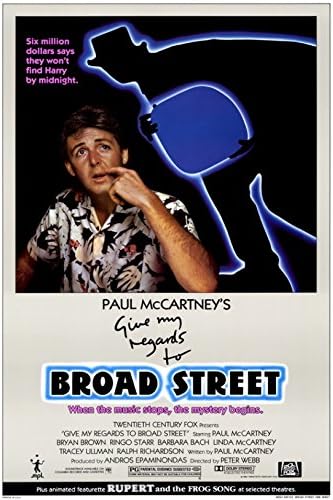
Film review: Give My Regards to Broad Street

Give My Reagrds to Broad Street movie

Give My Regards To Broad Street is an absolute blast, but only if you adopt the following strategy.  Every time you find yourself scratching your head at an illogical plot point or a random sequence that appears to have nothing to do with the rest of the film, repeat this mantra: ‘Paul is the Beatle King, he can do anything’.  Accept that, because of his song writing genius, McCartney had earned the absolute right to do what the hell he liked with his expensive, self indulgent folly of a film and you will have a very enjoyable 1hr and 48mins.

Ignore the damning 20% Rotten Tomatoes score and the savage reviews (in his one star review, Roger Ebert said, ‘Broad Street supplies us with a fake crisis, paper-thin characters, and long musical interludes that have been photographed with a remarkable lack of style…the movie treads water with idiotic dream sequences’). Ignore that the film took $1.4mill at the box office but cost $9mill to make. You even have to put aside McCartney’s own opinion that trying to extend what was originally planned to be a one hour TV special (that makes sense; Broad Street shares the rambling, illogical and episodic nature of Magical Mystery Tour) to a feature length film just didn’t work. In Conversations with McCartney, he told author Paul Du Noyer, ‘A feature film has got to have some dynamics, some strength and depth. We didn’t really get round to that…There’s a couple of redeeming features about it, but it’s just not very good.’

Technically, that is true. If you’d paid good money to see the film at the cinema in 1984 you’d have every right to be bitterly disappointed and even to demand a refund. But as this is 2023, you can watch Broad Street for free on YouTube and any true McCartney fan won’t resent investing a little under two hours of their lives to do so.

Broad Street is like an updated Help! but far less offensive (thankfully, racial stereotyping and brownface actors do not feature this time around). Just substitute Ringo’s ring for stolen master tapes as the film’s McGuffin and Leo McKern’s dastardly Clang for John Bennet’s sinister Mr. Rath as the villain of the piece and you have the makings of a plot just about sturdy enough to support a string of musical numbers, dream sequences and dialogue scenes that are meant to represent one day in the life of a rock star.

There’s no real jeopardy and the resolution to the mystery of what happened to those missing tapes (apparently worth £5million; gosh, how thrilling) is laughably weak and not worth waiting for. McCartney, despite having cast himself in the lead role had apparently failed to take a single acting lesson since Help! (or Magical Mystery Tour). So why is Broad Street worth your time?

The first and most obvious thing is the music. Who doesn’t want to watch McCartney sing Beatles classics including ‘Yesterday’ and ‘Here There and Everywhere’ with George Martin looking on from the studio control room (where Geoff Emerick is playing the recording engineer) while Ringo clowns around in the background, trying to find a pair of brushes to play his drums with that you know he’s going to locate just as McCartney plays a final chord.

There’s a brilliant set piece that brings the otherwise rather ordinary song ‘Ballroom Dancing’ to vibrant life, with an all star band that includes Ringo, Dave Edmunds, Chris Spedding and John Paul Jones strutting his stuff in a way he never got the chance to in Led Zeppelin. With a touch of very 80s-style androgyny, Paul and Linda face each other across upright pianos, dressed in matching teddy boy-style blue drape suits. Similarly ‘Not Such a Bad Boy’, which sounds unremarkable when heard on the soundtrack album makes a lot more sense when you see it played with gusto in a faux rehearsal set up with Ringo, Edmunds and the always effortlessly cool Spedding. McCartney looks like he’s having a ball and therefore so do we.

Even the utterly barmy staging of ‘Silly Love Songs’, with the entire band dressed in none-more-80s Toyah-esque garb and Jeffrey Daniel from Shalamar moonwalking and miming out front is a hoot (re-recorded for the film, the version features some fantastically funky playing from Brother’s Johnson bass man Louis Johnson, although he doesn’t appear in the film). While the period costume ‘Elanor’s Dream’ sequence, set to an extended orchestrated version of ‘Elanor Rigby’ doesn’t make an awful of sense, it does at least look grandly cinematic (it’s also reminiscent of the fantasy sequences in Led Zeppelin’s concert film The Song Remains the Same).

It’s also fascinating to see a glimpse of London’s past. By the early 90s, Butlers Wharf near Tower Bridge, where the rehearsal scenes are set, would be gentrified with pricy loft apartments and expensive restaurants, but in the early 80s it was still mostly derelict. A few years after filming, Broad Street railway station, where the film’s, er, ‘climatic’ scene is set, was closed and replaced by what is now Bishopsgate. The closure by the way was due to travellers switching to the London Underground and not fall out from its association with McCartney’s less than magnum opus.

As well as the musical legends mentioned above, the film’s cast includes everyone from Shakespearean actor Ralph Richardson to wrestler Giant Haystacks, comedian Tracy Ulman and Aussie star Bryan Brown (you may have seen him juggling shakers behind the bar with Tom Cruise in Cocktail) and a ton of British character actors such as Philip Jackson and Christopher Ellison which all adds to the entertainment value, at least for viewers of a certain age.

Watching Broad Street, it’s pretty obvious why McCartney decided not to pursue a second career in screenwriting and hasn’t made another feature film since (losing £7.6million probably helped in that particular decision making process). But fans should be glad that he gave it a go, however messy and idiosyncratic the results. The film has a kind of mad energy that keeps your eyes fixed to the screen. It’s never boring because you never quite know what’s going to happen next. While I’d never recommend it to the average viewer, for true Beatle-believers it’s a must watch. Just keep the mantra in mind, ‘Paul is the Beatle King, he can do anything’.

Beatles Handbook rating: 4 stars
Buy the album: Give My Regards to Broad Street

Movie review: If These Walls Could Sing

If-these-walls-could-sing

On 30th May 2022, I walked up the fabled steps of Abbey Road Studios, guitar in hand, heart in mouth. I was there to record with my band, The Stylus Method, for our second album, The Imaginary Costume Party. Anyone who has made the pilgrimage to St. John’s Wood will be familiar with the magic feeling the place conjures, despite its understated external appearance and sleepy surroundings. Entering the rabbit-warren of connecting corridors, stairways and secret passages adorned with the faces of musical and cinematic greats, I felt honoured to be contributing to the rich seam of sound recorded here. I hoped to mine some of those jewels during my own musical journey there.

Mary McCartney’s new documentary If These Walls Could Sing, celebrating the 90th anniversary of Abbey Road Studios, re-creates that feeling in its opening sequence. As narrator, she even makes the same point: ‘every time I walk through these corridors it feels magical’. Some flashing glimpses of a young George Harrison with his 12-string Rickenbacker and Wings-era Paul and Linda standing on Studio 2’s parquet floor help to set the scene for what follows.

90 minutes for 90 years is barely enough time to scratch the surface and it must have been a difficult task to narrow down the shortlist of contributors. However, the stories and interviews selected are rather hard to argue with. The film begins in 1931 with the black and white genesis of Abbey Road, its inaugural recording/performance of Sir Edward Elgar conducting a live orchestra through his ‘Land of Hope and Glory’, cut straight to a 78rpm disc. McCartney then traces the transition from classical to pop and back again. Cliff & The Shadows, Cilla Black, Gerry Marsden, Pink Floyd, Fela Kuti, Nile Rodgers, Kate Bush, Oasis and Celeste are bookended by performances of Elgar’s ‘Cello Concerto in E minor, Op.85′ by Jacqueline du Pré in 1967 and Sheku Kanneh-Mason in 2022, demonstrating the expanse of genres to flourish at Abbey Road, still the place to be to record the world’s greatest music.

Sir Elton John and Jimmy Page recall their days as young session players. The reverence with which they talk of Abbey Road and the musicians with whom they worked in those days is genuinely humbling and shows the power of music in bringing together and inspiring a community of like-minded creatives.

Perhaps the most interesting section of the film is the studios’ survival story, through the drought of bookings in the late 1970s & early 1980s when Studio 1 was relegated to a staff badminton court (and nearly converted into a car park) before being rescued by the tireless work of its staff and a renaissance in film music. Legendary composer John Williams of Star Wars fame provides some delightful insights, including his memories of the studio canteen (which I can confirm from experience serves extremely good roast potatoes). Rather perfectly, the London premiere of If These Walls Could Sing was the first ever to be hosted in Studio 1.

While the coverage of the Fabs’ time at Abbey Road is substantial, the film’s focus is not on the Beatles themselves or their music; it’s on the people at Abbey Road who made it happen (and continue to reinvent it) or, as Paul describes them, the ‘really cool boffins’. From the great George Martin – Ringo putting it eloquently, that ‘George was incredible and we were buskers’ – the tireless work of Ken Townsend, starting out as a trainee engineer in 1950 to retiring as studio chairman in 1995, faithful veteran technician Lester Smith and insights from current studio manager Colette Barber, the commitment to Abbey Road transcends simply what these people do for work; it is love.

It’s always spine-tingling to hear the surviving Beatles talk about ‘The Beatles’ and there’s plenty of that to enjoy. Paul seems genuinely excited to be there, in Studio 2, giving us a rollicking rendition of ‘Lady Madonna’ on the Mrs Mills piano and proclaiming the essence of what Abbey Road meant to the 1960s cultural revolution: ‘here you were in London, which was on fire’.

There are also some choice quotes (and drumming) from Ringo, who is looking fabulous, revealing his favourite song is ‘Yer Blues’. On Paul, he says, ‘if it hadn’t’ve been for him we’d have made like three albums’ and, on The Beatles, ‘it worked out pretty well for us’. You could say that Ringo.

The film includes archive clips we’ve all seen before, like the December 1966 interviews of the newly moustachioed Fabs arriving to work on the Sgt. Pepper sessions or the discussion of John’s ethereal vocal in ‘A Day In The Life’ (from the Anthology series). However, the words from Giles Martin are rather touching, picking up where his dad left off in similar no-nonsense terms that ‘it’s the four of them in a room making a sound together’ which is, perhaps, the most valuable asset of any great recording studio: a space in which people can create music together.

What Mary McCartney does with this film is to illustrate the cultural (or countercultural) significance of Abbey Road. A contemporaneous poetic critique of Sgt. Pepper from Allen Ginsberg gives credence to Roger Waters’ comment that this music gave musicians ‘permission to write songs about real things’ and ‘the courage to accept your feelings’. For, in this building, an entire artistic movement was born, not just a musical one but something much greater and enduring, spanning continents and lasting generations.

In that pursuit, we’re treated to some lovely archive clips such as Paul conducting the orchestra for ‘A Day In The Life’ (complete with clown noses and bald wigs) and a voice-over from George Harrison on the ‘All You Need Is Love’ filmed performance in Studio 1, its technicolour contrasting with the earlier Elgar scene in the same room. In one of the film’s finest moments, we’re shown a clip of Blackbird from the White Album sessions in 1968 (the year before Mary was born) kept in time by the tapping of Paul’s yellow and red shoes. Then, 56 years later, he plays a snippet of the song for his daughter’s camera. Reference to the unstructured Get Back/Let It Be project and a return to Abbey Road for the album of the same name provides a clever dramatic irony for the 2023 audience. The chaos of the former rectified by the latter which, in turn, now officially gives its name to the studios themselves.

Shown working on new music in Studio 3, Nile Rodgers observes that ‘so many massive rock and roll records were made here, people don’t believe that it was just done by accident’. The inherent superstition of musicians will mean that we’ll never know. However, despite the ‘smell of fear’ one might experience upon entering this hallowed ground to commit recorded sound to the history books, If These Walls Could Sing reminds us that Abbey Road is not a pretentious place.

The mark of a good documentary, Mary McCartney rarely emerges from behind the camera, instead seeking to capture the magic of Abbey Road which, for all its history and legend, is not just surviving on past glories, in fact, quite the opposite. It’s more than the name, the zebra crossing or the album cover. This is the most unlikely underdog story of what is still a working studio, and probably the best one in the world.

The studio hasn’t been made over or even tidied up for the documentary. Equipment isn’t pushed to one side to make room for better camera angles. The interviews in Studio 2, particularly those with Paul and Ringo, show cables, baffles and ‘sleeping bag’ dampers in the background and, from the door to the echo chamber to the stairs and god-like control room window, it looks just the same as it did in 1963 for the Please Please Me full-day album session culminating in, as Giles Martin puts it, ‘John’s ripped vocal’ in ‘Twist And Shout’.

For a British institution like Abbey Road, it’s rather frustrating that our American friends were able to watch If These Walls Could Sing two weeks before us, but it was well worth the wait (and a Disney subscription). Fittingly, this film stresses the eccentric Britishness of it all. Noel Gallagher describes the spirituality of the place akin to record shops, pubs, and football stadiums, while Giles Martin analogises that you’re never meant to clean out a teapot: ‘you walk down into Studio 2 and you feel as though the walls are saturated with great music’.

Why is Abbey Road still the greatest place on Earth to record? For all its mysticism, maybe the simple answer lies in the following two quotes:
– ‘People want to come here, they want the sound of Abbey Road’ (Sir Elton John).
– ‘All the microphones work’ (Sir Paul McCartney) – something which will resonate with musicians everywhere who have ever paid for studio time.

The Beatles Handbook rating: 4 stars

Review written by Jordan Frazer. Follow him on Twitter at @TheStylusMethod and find out more about the band at Bandcamp